

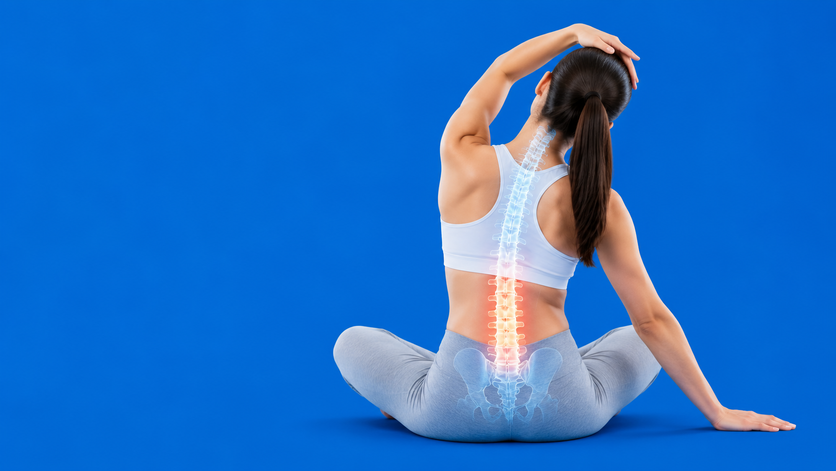
The most common question our physiotherapists are asked — by patients who are recovering from back pain, neck pain, or a spinal injury — is some variation of this: “What can I do at home to help?”
The answer is always the same. A short, consistent morning routine that prepares the spine for the demands of the day ahead.
Not an hour-long gym session. Not an elaborate flexibility programme. Five targeted exercises, performed correctly, taking no more than ten to fifteen minutes — ideally before you sit down at your desk, get in your car, or begin whatever your day requires of your body.
The five exercises in this article have been selected by our clinical team specifically for the Abu Dhabi population — people who spend long hours sitting, driving, or working in physically demanding jobs, and whose spines need active, daily support to stay healthy and pain-free.
They are not complicated. But they are clinically important. And performed consistently, they make a meaningful difference.
Why a Morning Spine Routine Matters
During sleep, the intervertebral discs reabsorb fluid and swell slightly — which is why you are actually a few millimetres taller in the morning than you are by evening. This also means the spine is at its most hydrated and, in some respects, most vulnerable first thing in the morning. The discs are under slightly higher pressure than later in the day, and the surrounding muscles have been inactive for seven or eight hours.
A gentle morning routine serves several important purposes:
- It restores spinal mobility after the relative immobility of sleep
- It activates the core and stabilising muscles before they are called upon to protect the spine during daily activity
- It improves circulation to the spinal discs and surrounding soft tissues
- It establishes a positive movement habit that carries protective benefits throughout the day
- It provides a daily “check-in” with your body — allowing you to notice areas of stiffness or discomfort before they develop into significant pain
Think of it as the equivalent of warming up before exercise — except the exercise is your entire day
Before You Begin: Important Notes
These exercises are appropriate for most adults with general back or neck stiffness, postural pain, or as a preventive routine for those without current symptoms. They are not appropriate as a substitute for professional assessment if you have significant pain, nerve symptoms (numbness, tingling, or weakness), or a diagnosed spinal condition.
If any exercise causes increased pain or produces radiating symptoms into the arm or leg, stop immediately and seek physiotherapy assessment
Perform each exercise on a firm but comfortable surface — a yoga mat on the floor is ideal.
Exercise 1: Knee Rolls (Lumbar Mobility and Decompression)
Why it matters: After eight hours of sleep in a relatively fixed position, the lumbar spine needs gentle rotational movement to restore mobility and reduce morning stiffness. Knee rolls are one of the safest and most effective ways to achieve this.
How to do it:
- Lie on your back with your knees bent and feet flat on the floor, arms extended out to the sides at shoulder height.
- Keeping your knees together and your upper back and shoulders in contact with the floor, slowly lower both knees to one side as far as is comfortable.
- Hold for two to three seconds, then slowly return to the centre and lower to the other side.
- Repeat 8–10 times each side, moving slowly and breathing steadily throughout.
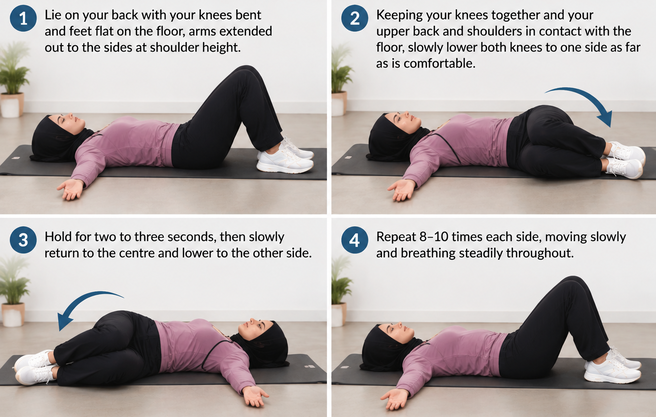
What you should feel: A gentle stretch and release through the lower back and hip area. You may feel or hear some clicking in the lumbar joints — this is normal and typically indicates that stiff joints are beginning to move.
What to avoid: Do not force the knees to the floor. The movement should be pain-free and controlled. If one side is significantly stiffer or more uncomfortable than the other, note this and mention it to your physiotherapist.
Exercise 2: Cat-Cow (Spinal Flexion and Extension Mobility)
Why it matters: Cat-cow mobilises the entire spine from the sacrum to the cervical region through its two primary movements — flexion and extension. It restores the fluid, segmental movement of the vertebrae that prolonged sitting and sleeping progressively reduces. It also gently activates the deep spinal muscles and promotes disc hydration.
How to do it:
- Begin on all fours with your hands directly below your shoulders and your knees directly below your hips. Your spine should be in a neutral, flat position.
- Cat: Slowly exhale as you round your entire spine upward — tucking the pelvis under, drawing the belly button toward the spine, dropping the head, and pushing the upper
back toward the ceiling. Hold for two seconds. - Cow: Slowly inhale as you reverse the movement — letting the belly drop toward the floor, lifting the tailbone and the crown of the head, and allowing the lumbar spine to
arch gently. Hold for two seconds. - Move between the two positions slowly and rhythmically for 10–12 repetitions, synchronising the movement with your breathing.
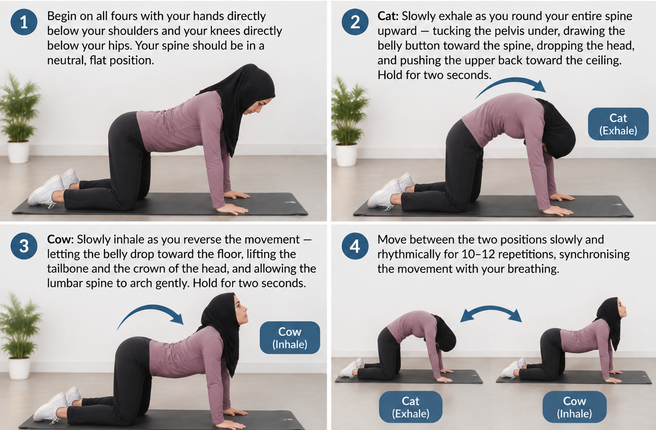
What you should feel: A flowing, wave-like movement through the entire spine. Each vertebra should feel like it is participating in the movement. Morning stiffness often means the first few repetitions feel restricted — this is normal and typically improves within the set.
What to avoid: Do not force the range of motion, particularly in the extension (cow) position if you have known lumbar disc problems. Work within a comfortable range and gradually explore greater movement over time.
Exercise 3: Deep Cervical Flexor Activation (Chin Tucks)
Why it matters: The deep cervical flexors — a group of muscles at the front of the neck — are the primary stabilisers of the cervical spine. In people who spend significant time with a forward head posture (which is most of us), these muscles become weak and inhibited, placing the neck at increased risk of pain and injury. Reactivating them daily is one of the
single most important things an office worker can do for their cervical spine health.
How to do it:
- Lie on your back with your knees bent and a thin pillow or folded towel supporting your head in a neutral position.
- Without lifting your head from the surface, gently draw your chin straight back toward the pillow — as if making a “double chin.” You should feel a gentle lengthening at the base of the skull and a subtle activation of the muscles at the front of the neck.
- Hold for 5–10 seconds, breathing normally throughout. Release slowly.
- Repeat 10 times
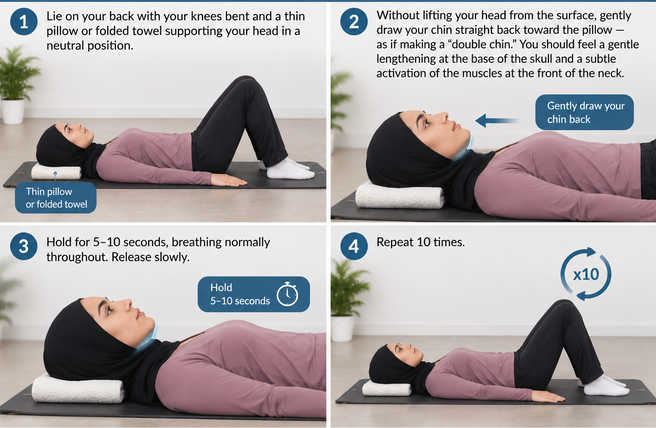
What you should feel: A gentle, subtle activation at the front of the neck. This is not a strong, forceful exercise — it is a precise, low-load activation of deep muscles. If you feel the large muscles at the side of the neck working hard, the effort level is too high.
What to avoid: Do not nod the head, tilt it, or lift it from the surface. The movement is purely a retraction — straight back, not up or down.
Exercise 4: Glute Bridges (Gluteal and Core Activation)
Why it matters: The gluteal muscles are among the most important stabilisers of the lumbar spine and pelvis. In people who sit for long periods, the glutes become inhibited — they switch off and stop contributing effectively to spinal support and movement control. The result is that the lower back muscles have to compensate, working far harder than they
should and becoming prone to fatigue and pain. Daily glute activation is essential for spinal
health in any desk-working population.
How to do it:
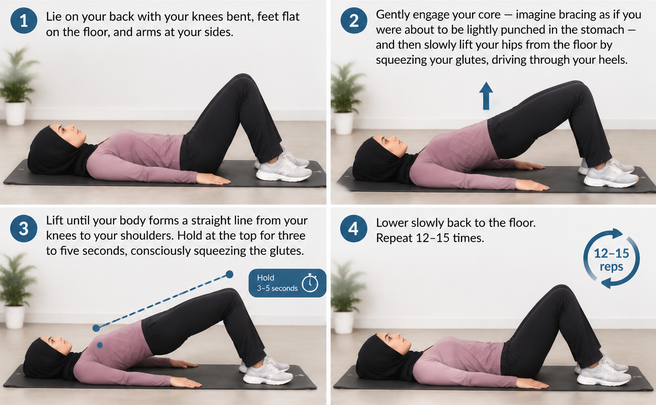
- Lie on your back with your knees bent, feet flat on the floor, and arms at your sides.
- Gently engage your core — imagine bracing as if you were about to be lightly punched in
the stomach — and then slowly lift your hips from the floor by squeezing your glutes,
driving through your heels. - Lift until your body forms a straight line from your knees to your shoulders. Hold at the
top for three to five seconds, consciously squeezing the glutes. - Lower slowly back to the floor. Repeat 12–15 times.
What you should feel: A clear activation in the gluteal muscles — the muscles of the buttocks. If you feel this primarily in your hamstrings or lower back, your glutes are not activating effectively. In this case, try placing a resistance band just above the knees and pushing them slightly apart as you lift — this cue helps many people feel the glutes engage.
What to avoid: Do not hyperextend the lower back at the top of the movement. The bridge
position should be a straight line from knees to shoulders — not an arch.
Exercise 5: Thoracic Extension Over a Rolled Towel (Thoracic Mobility)
Why it matters: The thoracic spine — the segment attached to the ribcage — is the most commonly stiffened area of the spine in desk workers, drivers, and anyone who spends prolonged time in a flexed, rounded posture. Thoracic stiffness directly contributes to both neck pain and lower back pain, because the segments above and below must compensate for the lack of movement in the mid-spine. Daily thoracic extension is one of the most powerful — and most underused — tools for spinal health.
How to do it:
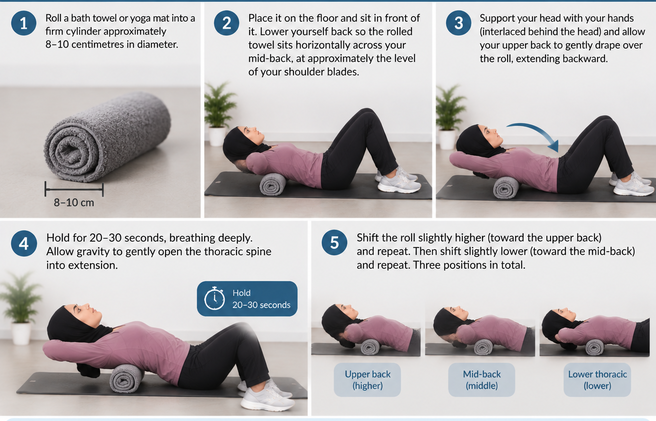
- Roll a bath towel or yoga mat into a firm cylinder approximately 8–10 centimetres in diameter.
- Place it on the floor and sit in front of it. Lower yourself back so the rolled towel sits horizontally across your mid-back, at approximately the level of your shoulder blades.
- Support your head with your hands (interlaced behind the head) and allow your upper back to gently drape over the roll, extending backward.
- Hold for 20–30 seconds, breathing deeply. Allow gravity to gently open the thoracic spine into extension.
- Shift the roll slightly higher (toward the upper back) and repeat. Then shift slightly lower
(toward the mid-back) and repeat. Three positions in total.
What you should feel: A gentle opening and release through the mid and upper back. You may feel or hear some clicking in the thoracic joints — this is generally a sign of stiff joints beginning to mobilise and is normal.
What to avoid: Do not place the roll in the lower back. This exercise is specifically for the thoracic spine. If you experience sharp pain rather than a stretching sensation, stop and seek physiotherapy advice.
Making It a Habit
The most effective exercise routine is one that is done — not one that is perfect. Ten minutes performed consistently every morning produces far greater benefit than an elaborate programme performed sporadically.
Our recommendation is to do this routine immediately after getting out of bed — before coffee, before your phone, before anything else. Attach it to your morning routine as a fixed habit. Within two to three weeks, most patients report that the routine feels natural, takes less than ten minutes, and that their mornings feel noticeably different — less stiff, less painful, and more prepared for the day ahead.
When Exercises Are Not Enough
These five exercises are preventive and maintenance tools. They are designed to support a healthy spine, not to treat a symptomatic one. If you are currently experiencing significant back or neck pain, nerve symptoms, or have a
diagnosed spinal condition, these exercises should be performed under physiotherapy guidance and tailored to your specific clinical presentation. What is appropriate for one person may be contraindicated for another — and performing the wrong exercises for a specific spinal problem can occasionally make things worse.
If you are unsure whether this routine is appropriate for your situation, book an assessment with our team. We will guide you through the exercises, confirm they are right for your spine, and add any additional targeted interventions your individual situation requires.
The Health & Style Commitment
At Health & Style Medical Centre, we believe that the best outcome for our patients is one that makes them less dependent on us — not more. A patient who has the knowledge, the exercises, and the body awareness to protect their own spine is a patient who is far less likely to need repeated clinical intervention.
These five exercises represent a foundation. Our job is to build on that foundation with expert assessment, targeted treatment, and the education that empowers you to take control of your spinal health for the long term.
Book your assessment at Health & Style Medical Centre, Abu Dhabi.