

If you have ever been advised to rest after surgery, an injury, or a painful joint flare-up, you may know how challenging it can be to start moving again without triggering the pain all over.
You understand the frustrating cycle that slows recovery down.
You want to move. Movement is how the body heals. But movement hurts. So you rest more. And the muscles weaken. And the next attempt is even harder.
The Anti-Gravity Treadmill breaks that cycle.
At Health & Style Medical Centre in Abu Dhabi, we have introduced Anti-Gravity Treadmill therapy as part of our physiotherapy and rehabilitation programme — because for a growing number of our patients, it is the difference between a recovery that stalls and one that progresses steadily from week one.
Here is everything you need to know about what it is, why it works, and whether it might be right for you.
What Is an Anti-Gravity Treadmill?
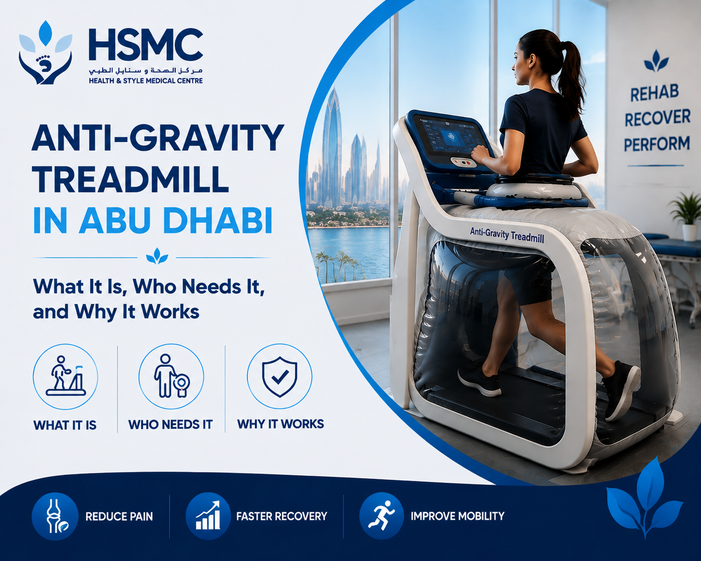
An Anti-Gravity Treadmill is a specialised rehabilitation device that uses air pressure to reduce the amount of body weight a person carries while walking or running.
The technology was originally developed by NASA to help astronauts maintain fitness during long periods in zero gravity. It was later adapted for sports medicine and rehabilitation — and is now used in elite sports facilities, rehabilitation hospitals, and specialist physiotherapy clinics around the world.
The mechanics are straightforward. The patient steps into a sealed chamber that fits around the waist — similar to a pair of shorts connected to the treadmill frame. The chamber is inflated with air, which creates an upward lifting force on the lower body. This force counteracts gravity — reducing the effective weight that the legs and joints have to carry with each step.
The amount of unweighting is precise and adjustable. Your physiotherapist can set the reduction anywhere between 1% and 80% of your body weight — in increments as small as 1%. A patient who normally weighs 80kg can walk on the treadmill as if they weigh just 16kg. A runner who cannot bear full weight on a healing stress fracture can run at 40% body weight while the bone repairs.
The brain still sends the same walking signals. The legs still perform the same movements. The cardiovascular system still benefits from the exercise. The only thing that changes is how much load the muscles and joints have to absorb with every step.
Why Is Reduced Body Weight So Important for Recovery?
When you walk, run, or climb stairs, your knees absorb a force equivalent to approximately three to five times your body weight with each step. Your hips absorb a force of two to three times your body weight. After surgery, injury, or during a period of joint inflammation, these forces — even at walking pace — can be enough to cause pain, delay healing, or risk re-injury.
The traditional approach to this problem is rest. Crutches, reduced activity, and patience. For many patients this works eventually — but it comes with significant costs. Muscles weaken during inactivity. Cardiovascular fitness drops. The neural patterns that control normal walking begin to degrade. When full weight bearing is finally allowed, the patient is weaker than when they started — and often more afraid of pain than before.
The Anti-Gravity Treadmill offers a different approach. By reducing body weight precisely and progressively, patients can start moving — walking, running, rehabilitating — from a much earlier stage of recovery than would otherwise be possible. The muscles stay active. The cardiovascular fitness is maintained. The brain continues to practise normal movement patterns. And when the treadmill weight is gradually increased back toward 100%, the body is ready for it.
This is not a shortcut. It is a smarter, more gradual path to the same destination.
Who Should Use an Anti-Gravity Treadmill?
The Anti-Gravity Treadmill is not only for elite athletes — although professional sports teams and Olympic training programmes use it extensively. At HSMC Abu Dhabi, we see a wide range of patients who benefit significantly from this technology.
Post-Surgical Rehabilitation
This is the most common reason patients use the Anti-Gravity Treadmill at HSMC. After joint replacement surgery — knee replacement, hip replacement, or ankle reconstruction — the surgical site needs time to heal, but the muscles and movement patterns need stimulation to recover properly.
The Anti-Gravity Treadmill allows patients to begin progressive weight bearing from the early stages of post-surgical recovery — in a controlled, safe, pain-managed environment. Patients who begin treadmill rehabilitation early consistently show faster return to normal walking patterns and better outcomes at the three and six-month marks compared to rest-only recovery.
Sports Injury Recovery
For athletes — whether professional or recreational — the Anti-Gravity Treadmill addresses one of the most common and frustrating challenges in sports rehabilitation: how to maintain fitness while an injury heals.
A runner with a stress fracture cannot run at full weight. But they can run at 40% or 50% body weight — maintaining their cardiovascular fitness, their stride mechanics, and their mental engagement with their sport — while the bone repairs. A footballer with an ACL injury can begin running patterns on the treadmill weeks before they would be cleared for full weight bearing on a standard track.
This approach does not just accelerate physical recovery. It significantly reduces the psychological impact of injury — keeping athletes connected to their sport and confident in their body during a period that is often defined by loss of identity and frustration.
Chronic Joint Pain and Osteoarthritis
For patients with chronic knee or hip osteoarthritis, exercise is one of the most evidence-based treatments available. Strengthening the muscles around a degraded joint reduces pain and improves function. The problem is that for many patients with moderate to severe osteoarthritis, walking or exercising at full weight is painful enough to prevent them from doing it consistently.
The Anti-Gravity Treadmill allows these patients to exercise — walking and building strength — at a weight level that is below their pain threshold. Over time, as strength improves, the weight is gradually increased. Many patients find that after a programme on the Anti-Gravity Treadmill, they can walk further at full body weight with significantly less pain than before — because the supporting muscles are now stronger.
Neurological Rehabilitation
Patients recovering from strokes, managing multiple sclerosis, Parkinson’s disease, or other neurological conditions that affect gait and balance benefit significantly from the Anti-Gravity Treadmill. The reduced weight allows these patients to focus on correct movement patterns without the fear of falling. The treadmill supports them in an upright, weight-bearing position — which is itself therapeutic for many neurological conditions — while removing the risk of a fall during practice.
For stroke patients in particular, early ambulation — getting upright and moving as soon as possible — is associated with significantly better neurological outcomes. The Anti-Gravity Treadmill makes early ambulation possible even when the patient’s strength and balance would otherwise make it unsafe.
Obesity and Weight-Bearing Exercise
For patients who are significantly overweight and want to begin a walking or running programme, the joint impact of full body weight exercise can be a genuine barrier. Knee and hip pain during exercise discourages the very activity that would help most.
The Anti-Gravity Treadmill allows these patients to walk and run at a reduced effective weight — making exercise possible and pain-free from the start. As fitness improves and weight reduces, the unweighting percentage is gradually decreased. This is a particularly powerful tool when used alongside our medically supervised Weight Management Programme at HSMC.
Paediatric Rehabilitation
Children recovering from orthopaedic surgery or managing conditions that affect gait can benefit from the Anti-Gravity Treadmill under physiotherapy supervision. The ability to reduce weight while maintaining normal walking patterns is particularly valuable for children who are growing rapidly and need to rebuild movement confidence after injury or surgery.
What Are the Benefits of Anti-Gravity Treadmill Therapy?
Across all the patient groups above, the clinical benefits consistently observed include:
Earlier mobilisation
Patients begin moving sooner after surgery or injury than would be possible with standard rehabilitation equipment.
Reduced pain during exercise
By removing the load that causes pain, patients can exercise within a comfortable range — reducing the fear of movement that often accompanies chronic pain and post-surgical recovery.
Maintained cardiovascular fitness
Athletes and active patients can keep their aerobic fitness during recovery — making the return to sport significantly easier.
Preserved muscle mass
Inactivity causes muscle atrophy. The Anti-Gravity Treadmill allows muscle-stimulating activity even when full weight bearing is not possible.
Correct gait pattern maintenance — The brain continues to practise normal walking mechanics — preventing the compensatory movement habits that develop when people walk in pain for extended periods.
Psychological confidence
Patients who begin moving early in their recovery consistently report greater confidence in their body and lower anxiety about re-injury than those who remain inactive during the same period.
Progressive and measurable
Weight percentage is increased systematically — giving both the patient and the physiotherapist clear, measurable milestones throughout recovery.
What to Expect at Your First Session
Your first Anti-Gravity Treadmill session at HSMC begins with a physiotherapy assessment. Your physiotherapist reviews your condition, your surgical or injury history, your current pain levels, and your rehabilitation goals. From this assessment they determine the appropriate starting weight percentage — typically conservative in the first session and increased gradually.
You step into the pressurised shorts that attach to the treadmill chamber. The chamber seals and inflates around your waist. The inflation takes approximately 30 seconds and the sensation is a gentle upward pressure — most patients describe it as immediately noticeable and surprisingly comfortable.
The treadmill starts at a slow walking pace. Your physiotherapist monitors your gait, your posture, and your comfort throughout the session. A typical initial session lasts 20–30 minutes and is followed by a brief cool-down and a review of how the body responded.
Subsequent sessions progressively increase either the speed, the duration, or the body weight percentage — depending on how you have responded and what your recovery goals require.
Is the Anti-Gravity Treadmill Right for You?
If you are recovering from joint replacement surgery, a sports injury, a stress fracture, or a neurological event — or if you are managing chronic joint pain that makes normal exercise consistently painful — the Anti-Gravity Treadmill may significantly accelerate your recovery.
The best starting point is a physiotherapy assessment at HSMC. Your physiotherapist will evaluate your condition honestly and tell you whether the Anti-Gravity Treadmill is the right tool for your specific situation — or whether a different approach would serve you better.
Book Your Anti-Gravity Treadmill Session at HSMC Abu Dhabi
📲 WhatsApp: 055 511 6072
📞 Call: 02 633 0515
📍 Ground Floor, 906 Al Falah Street, Al Danah Zone 1, Abu Dhabi
🌐 healthstyle.ae
🕐 Open 7 days — Monday to Thursday 9am–9pm · Friday to Sunday 9am–5pm