

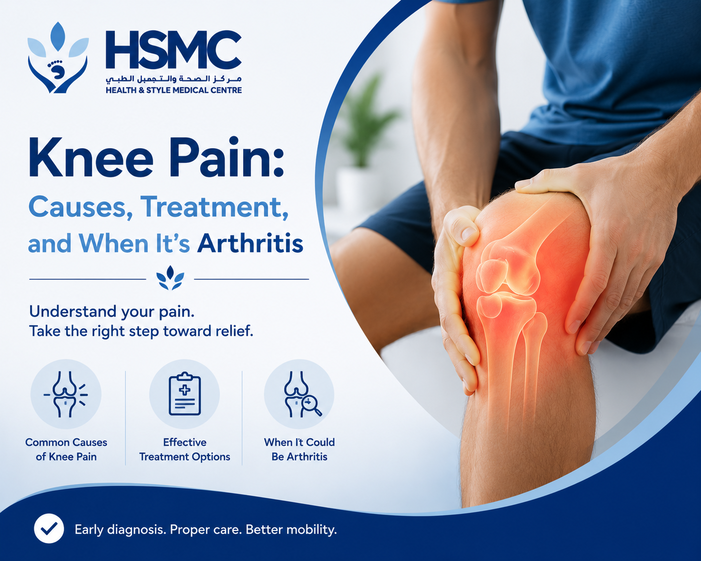
The knee carries up to five times your body weight on stairs — so when it hurts, everyday life shrinks
fast. Knee pain is the most common complaint in our orthopedic clinic, and also one of the most
treatable, provided the actual cause is identified. Here’s how a specialist thinks about knee pain
treatment, and how to tell an overload problem from early arthritis.
The Most Common Causes of Knee Pain
Knee Osteoarthritis
Gradual cartilage wear, typically after 50. Pattern: stiffness after sitting, pain on stairs (especially going
down), swelling after long days, and a knee that feels “older than you are.” Arthritis on an X-ray does
not automatically mean pain forever — severity of imaging and severity of symptoms often don’t match.
Meniscus Tears
The knee’s shock-absorbing cartilage can tear with twisting injuries (younger patients) or wear gradually
(older patients). Signs: clicking, catching, locking, or pain on twisting and squatting.
Ligament Injuries
ACL and MCL injuries follow sudden pivots and impacts — common in football and padel. A pop, rapid
swelling, and instability (“giving way”) need prompt assessment before any return to sport.
Patellofemoral Pain
Pain around or behind the kneecap, worse on stairs and after long sitting (“cinema sign”). Usually a
tracking and strength problem — and one of the best responders to structured rehabilitation.
Referred Pain
Sometimes the knee is the messenger, not the problem: hip conditions and foot mechanics (flat feet,
overpronation) both refer load and pain to the knee — one reason our orthopedic and podiatry teams
work together.
Red Flags: See a Specialist Promptly
- Swelling that appears within hours of an injury
- Locking, or inability to fully straighten the knee
- Instability or giving way
- Night pain, rest pain, fever, or a hot swollen joint
- Pain persisting beyond two weeks despite rest
Knee Pain Treatment: The Modern Approach
Conservative First
Most knees improve without surgery:
- Accurate diagnosis — examination plus digital X-ray; MRI referral when soft tissue detail is needed
- Physiotherapy-led strengthening — quadriceps, glutes, and hip control; the single most evidence-backed treatment for both arthritis and kneecap pain
- Weight optimisation — each kilogram lost removes roughly four from the knee on stairs
- Load management — modifying, not abandoning, activity
- Braces and supports for instability and arthritis flare-ups
- Addressing foot mechanics — orthotics when overpronation is driving knee load
Injections
Intra-articular corticosteroid injections calm arthritic flares and inflammatory pain, performed safely in
clinic. They are a bridge that enables rehabilitation — not a substitute for it.
Surgery — When Genuinely Needed
Arthroscopy for mechanical tears, and joint replacement for end-stage arthritis that has exhausted
conservative care. If surgery is right for you, we’ll say so plainly — and if it isn’t, we’ll say that too.
Frequently Asked Questions
Is walking good or bad for knee arthritis?
muscles. Pain lasting more than an hour afterwards means the dose was too high — reduce, don’t stop.
Do I need an MRI for knee pain?
meniscus/ligament injury or when findings would change the treatment plan.
Can knee osteoarthritis be reversed?
management, and flare control change the lived experience dramatically.
My knee clicks but doesn’t hurt — should I worry?
assessment.
Get Your Knee Properly Assessed
Knee pain rarely improves by guessing. At Health & Style Medical Center in Abu Dhabi, our orthopedic
specialists provide precise diagnosis, in-clinic injections, and rehabilitation coordinated with our own
physiotherapy and podiatry teams — conservative first, always honest
Book your knee assessment at healthstyle.ae — and take the stairs with confidence again.