

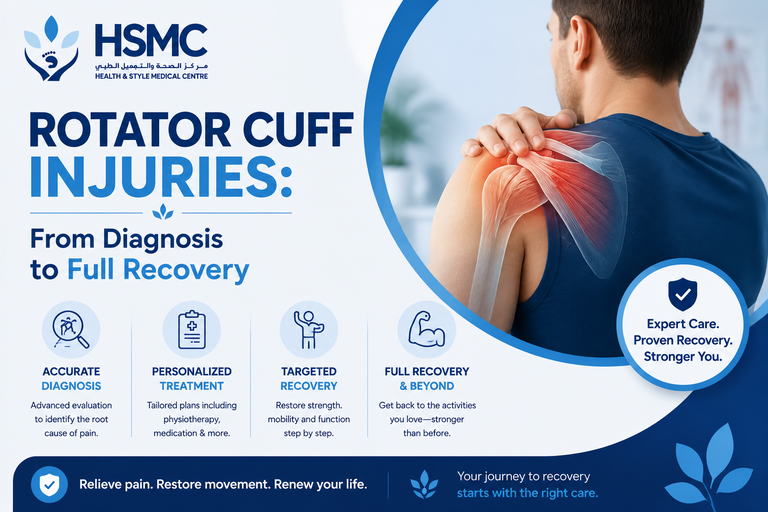
Reaching a high shelf, throwing a ball, fastening a seatbelt, sleeping on your side — the rotator cuff is involved in nearly everything your shoulder does. Which is why injuring it is so disruptive, and why night pain in the shoulder is one of the most common complaints in our orthopedic clinic.
Here’s what the rotator cuff actually is, how to tell tendonitis from a tear, and how modern rotator cuff injury treatment restores strength — with surgery reserved for the minority
who truly need it.
What Is the Rotator Cuff?
Four muscles and their tendons wrap the shoulder like a cuff, holding the ball centred in its shallow socket and powering rotation and lifting. Because the tendons pass through a narrow bony tunnel, they’re prone to irritation, degeneration, and tearing — from a single injury or, more commonly, years of accumulated load.
The Spectrum of Rotator Cuff Problems
Tendonitis & Impingement
Inflamed, irritated tendons pinched during overhead movement. Typical picture: a painful arc when lifting the arm, pain reaching behind the back, and aching after activity. Common in gym-goers, swimmers, padel players, and anyone with overhead work.
Partial-Thickness Tears
Fraying or partial tearing of the tendon — often an extension of chronic tendonitis. Pain is similar but more persistent, with early weakness.
Full-Thickness Tears
A complete tear through the tendon, from significant injury or end-stage degeneration. Hallmarks: weakness that doesn’t improve with pain relief, difficulty lifting the arm, and pronounced night pain. Important context: many people over 60 have painless tears
on scans — imaging findings must always be matched to your symptoms and examination.
The Telltale Symptoms
- Pain on the outer shoulder, often radiating toward the upper arm
- Night pain — especially lying on the affected side
- Pain or weakness reaching overhead or behind the back
- A painful arc between roughly 60° and 120° of lifting
- Clicking or catching with movement
Diagnosis: Getting It Right First
A specialist examination — strength testing of each cuff muscle plus impingement tests — localises the problem accurately. X-rays assess the bony tunnel and rule out arthritis; ultrasound or MRI is added when a tear is suspected or symptoms resist initial treatment. Precision here matters, because tendonitis, partial tears, frozen shoulder, and neck referred pain are all treated differently.
Rotator Cuff Injury Treatment
Conservative Care — the Right Start for Most
- Structured physiotherapy — the cornerstone: progressive cuff and scapular strengthening, coordinated between our orthopedic specialist and in-house
physiotherapy team; evidence shows outcomes for most tendonitis and many partial tears match surgery - Corticosteroid injection — for pain that blocks rehabilitation or sleep; a bridge into exercise, used judiciously to protect tendon quality
- Posture and technique correction — desk setup, gym form, serve mechanics
Expect meaningful progress over 6–12 weeks; tendons rebuild on tendon time, not muscle time.
When Surgery Enters the Conversation
- Full-thickness tears in younger or active patients
- Tears after significant trauma with real weakness
- Persistent pain and weakness despite 3–6 months of quality rehabilitation
If that’s you, we’ll explain the options honestly — including what repair involves and the rehabilitation commitment afterwards.
Frequently Asked Questions
Why is rotator cuff pain worse at night?
Will a rotator cuff tear heal on its own?
Can I keep training with rotator cuff pain?
How do I know it’s not frozen shoulder?
Rebuild a Strong, Pain-Free Shoulder
Shoulder pain that lingers is rarely solved by rest alone. At Health & Style Medical Center in Abu Dhabi, our orthopedic specialists provide accurate rotator cuff diagnosis, in-clinic injections when they genuinely help, and physiotherapy-led rehabilitation under one roof — so your shoulder gets stronger, not just quieter.
Book your shoulder assessment at healthstyle.ae.