

Abu Dhabi is a city built for cars. The distances between residential areas, business
districts, schools, and leisure destinations are vast. Public transport, while improving,
remains limited compared to the car-dependent reality of daily life. For the vast majority of
Abu Dhabi residents, the car is not just a convenience — it is a necessity.
And it is quietly damaging their lower backs.
The average Abu Dhabi commuter spends between 45 minutes and two hours in the car
every day. Add in school runs, weekend drives to Dubai, trips to malls and supermarkets,
and the cumulative driving time for many residents easily reaches two to three hours daily.
For some — particularly those who drive for work — it is considerably more.
When you combine this with eight or more hours of desk-based work, the result is a spine
that is spending the majority of its waking hours in a sitting position, under load, with little
opportunity for the movement and decompression it needs to stay healthy.
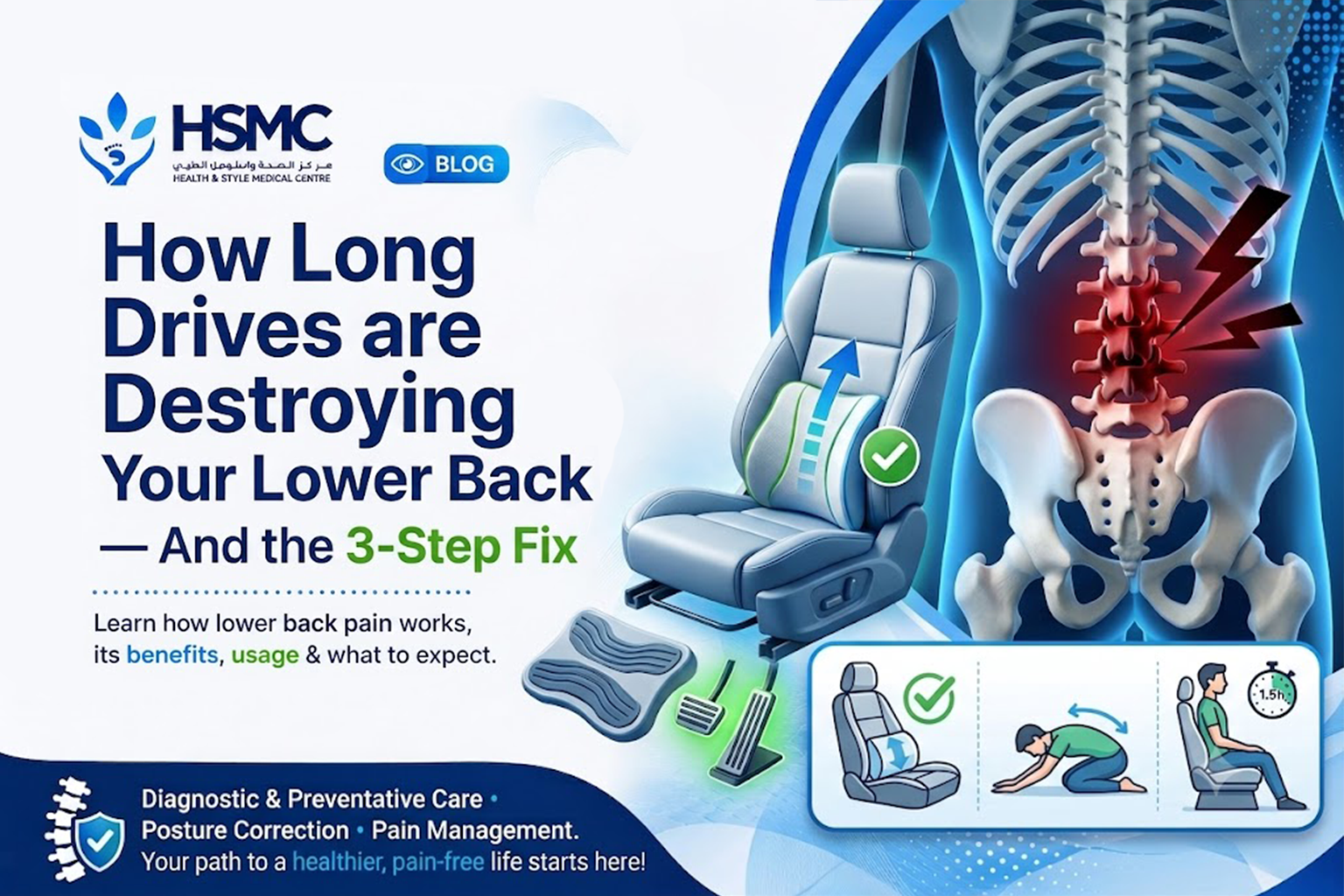
In this article, our physiotherapy team explains exactly why driving is so hard on the lower
back, what is happening in your spine during a long commute, and the three-step approach
we use to help Abu Dhabi drivers resolve and prevent lower back pain.
Why Driving is Hard on your Lower Back
Sitting at a desk is bad for the spine. Driving is worse. Here is why.
Sustained flexion under load. In a driving position, the lumbar spine is typically held in a
flattened or slightly flexed position — the natural inward curve of the lower back is reduced
or lost entirely. This position increases the pressure on the intervertebral discs and places
the posterior spinal ligaments and muscles under sustained tension. Unlike sitting at a desk,
where you might occasionally lean back or change position, driving requires a relatively
fixed posture for the entire duration of the journey.
Whole-body vibration. This is the factor that distinguishes driving from desk-sitting as a
spinal risk. Road surfaces produce vibration that travels through the car seat and into the
spine. Research has consistently identified whole-body vibration as a significant risk factor
for lumbar disc degeneration and lower back pain — particularly in people who are exposed
to it regularly and for long durations.
The vibration frequencies produced by road travel overlap closely with the natural
resonance frequency of the human spine — approximately 4–8 Hz — which means the spine
absorbs and amplifies road vibration rather than simply transmitting it. Over years of regular
driving, this accelerates disc degeneration and increases the risk of disc herniation.
Static muscle loading. Driving requires the postural muscles of the lower back and hips to
work continuously to stabilise the trunk against road vibration and maintain position. Unlike
walking or other dynamic activities, there is no opportunity for these muscles to rest and
recover — they are under sustained, low-level contraction for the entire journey. Over time,
this causes muscular fatigue, tension, and pain.
Hip flexor shortening. In the driving position, the hip flexors — particularly the iliopsoas —
are held in a shortened position for the duration of the journey. When these muscles
become chronically shortened, they tilt the pelvis forward and increase the compressive
load on the lumbar spine, contributing to lower back pain both during and after driving.
Awkward entry and exit. Getting in and out of a car requires a combination of hip flexion,
rotation, and load-bearing that places significant stress on the lumbar spine and sacroiliac
joints — particularly if done quickly or with poor technique. Many acute back pain episodes
occur during this seemingly mundane activity.
The Driving Posture Problem in Abu Dhabi
Who Is Most at Risk
- While any regular driver can develop driving-related lower back pain, certain groups are at
- particularly high risk:
- Commuters who drive more than 60 minutes per day
- Professionals who drive for work — sales representatives, delivery drivers, executives
- People who already have pre-existing lumbar disc degeneration or a history of back pain
- Those who combine long driving with prolonged desk sitting — doubling the daily sitting
- load on the spine
- Drivers of older vehicles with poor seat support or suspension
The 3-Step Fix
At Health & Style Medical Centre, we use a three-step approach to address driving-related
lower back pain. This approach works both as a treatment for established pain and as a
preventive strategy for drivers who want to protect their spine before problems develop.
Step 1: Optimise Your Driving Position
The first step is to ensure that your car seat is set up to support your spine as well as
possible, given the inherent physical demands of driving.
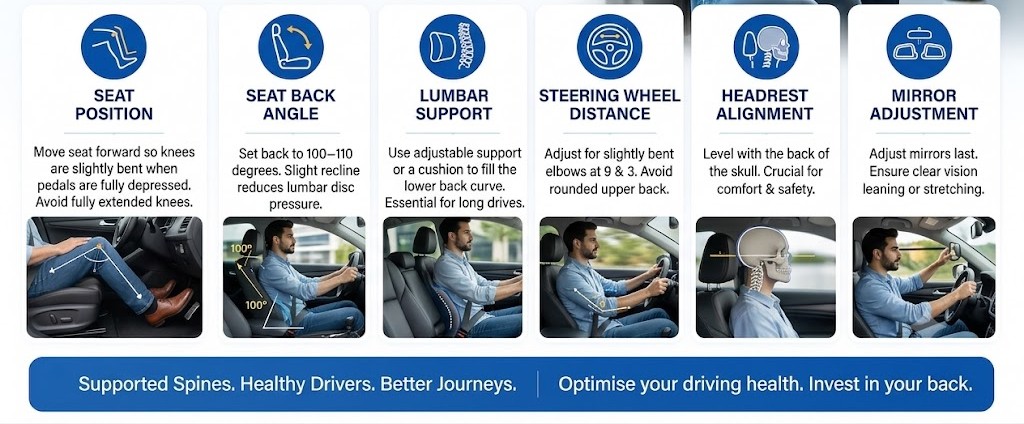
Seat position. Move the seat far enough forward that your knees are slightly bent when the
pedals are fully depressed. Your knees should not be fully extended — this position reduces
hip flexor tension and allows the pelvis to adopt a more neutral position.
Seat back angle. Set the seat back to approximately 100–110 degrees — slightly more
reclined than fully upright. A perfectly vertical seat back actually increases lumbar disc
pressure. A slight recline shifts some of the load from the discs to the seat back.
Lumbar support. If your vehicle has an adjustable lumbar support, position it so it fills the
natural inward curve of the lower back. If your vehicle does not have one — or if the built-in
support is insufficient — a purpose-designed lumbar roll or small cushion placed in the
small of the back is a simple and highly effective solution.
Steering wheel distance. Adjust the steering wheel so your elbows are slightly bent when
holding it at the 9 and 3 position. Reaching for a steering wheel that is too far away rounds
the upper back and increases the load on the lumbar spine.
Headrest. The headrest should be at the level of the back of the skull, not the neck. This is
important not just for comfort but for protection in the event of a collision.
Mirror adjustment. Adjust your mirrors after setting your seat position. If you need to
stretch or lean to see your mirrors clearly, your seat needs adjustment — or the mirrors do.
Step 2: Movement Breaks and Driving Hygiene
No matter how well your seat is set up, the human spine is not designed to remain static for
more than 30–45 minutes at a time. On long journeys, movement breaks are essential.
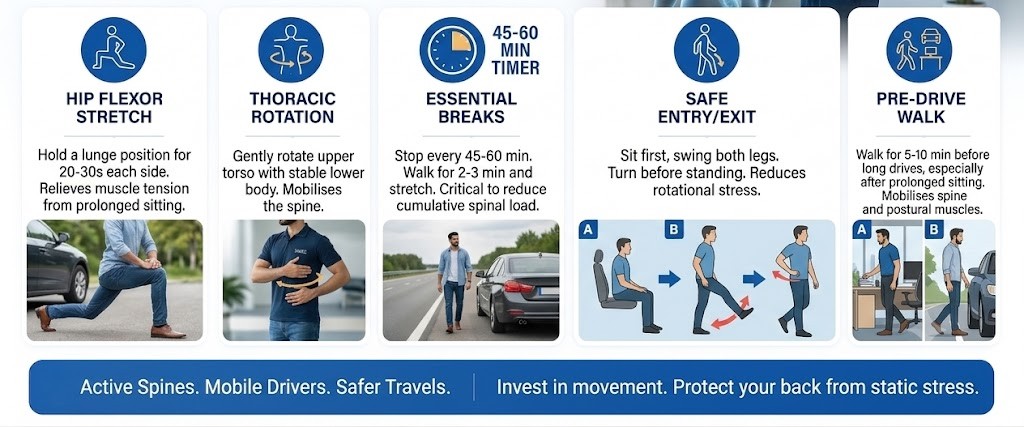
Stop every 45–60 minutes on long drives. Get out of the car, walk for two to three
minutes, and perform a few simple movements — standing lumbar extensions (hands on
lower back, gently arching backward), hip flexor stretches (a lunge position held for 20–30
seconds each side), and gentle thoracic rotation. This takes five minutes and significantly
reduces the cumulative load on the lumbar spine.
Getting in and out of the car safely. When exiting the vehicle, turn your entire body to face
the door before standing — do not twist and lift simultaneously. When entering, sit down
first and then swing both legs into the vehicle together. These simple techniques
dramatically reduce the rotational stress on the lumbar spine and sacroiliac joints.
Avoid driving immediately after prolonged sitting. Where possible, take a short walk
before a long drive rather than going directly from desk to car. This mobilises the spine,
activates the postural muscles, and reduces disc pressure before the additional load of
driving is added.
Step 3: Targeted Physiotherapy Rehabilitation
The first two steps address the driving environment and habits. The third step addresses
what is happening inside the body — and this is where physiotherapy makes the difference
that lasting recovery requires.
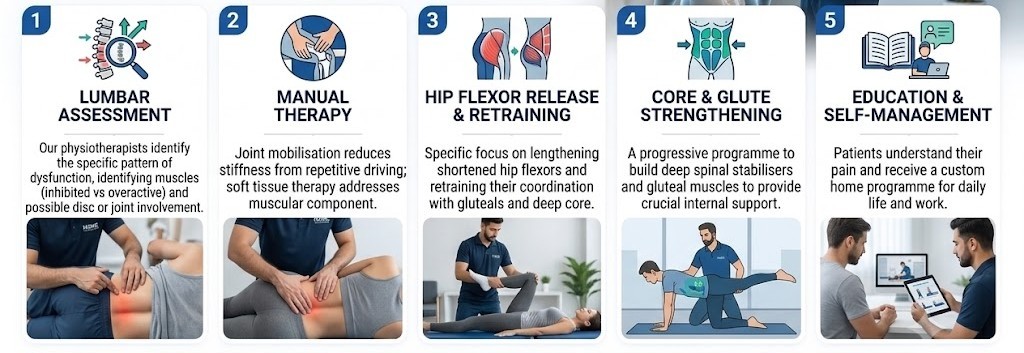
Lumbar assessment. Our physiotherapists assess the specific pattern of dysfunction in
your lower back — the direction of movement loss, the muscles that are overactive and
those that are inhibited, the presence of any disc, facet joint, or nerve involvement — and
identify the primary drivers of your pain.
Manual therapy. Hands-on joint mobilisation of the lumbar and sacroiliac joints addresses
the stiffness and restriction that builds up with repetitive driving. Soft tissue therapy to the
hip flexors, lumbar extensors, and gluteals addresses the muscular component.
Hip flexor release and retraining. Because the hip flexors are so consistently involved in
driving-related lower back pain, we dedicate specific attention to lengthening shortened hip
flexors and retraining their coordination with the gluteals and deep core — restoring the
muscular balance that chronic driving disrupts.
Core and gluteal strengthening. A progressive programme to strengthen the deep spinal
stabilisers and gluteal muscles reduces the load on the passive structures of the lumbar
spine and provides the internal support system the discs and facet joints depend on.
Education and self-management. We ensure that every patient leaves with a clear
understanding of why their back hurts, what they can do about it in their daily driving and
work life, and a home exercise programme that maintains the gains made in treatment.
The Long-Term Picture
Driving-related lower back pain is not a condition that responds to rest and time alone. The
cause — driving — is not going away. Abu Dhabi’s road culture is not changing. What must
change is the way drivers prepare their bodies for the demands of daily driving, and the way
they respond when pain begins to develop.
With the right approach, virtually every case of driving-related lower back pain can be
successfully managed. The drivers who do best are those who address it early, implement
the postural and behavioural changes, and commit to the rehabilitation programme that
builds the physical resilience their spine needs to cope with Abu Dhabi’s road demands.
Book your lower back assessment at Health & Style Medical Centre, Abu Dhabi.

- Tags:
- Back Pain
- Lower Back Pain