

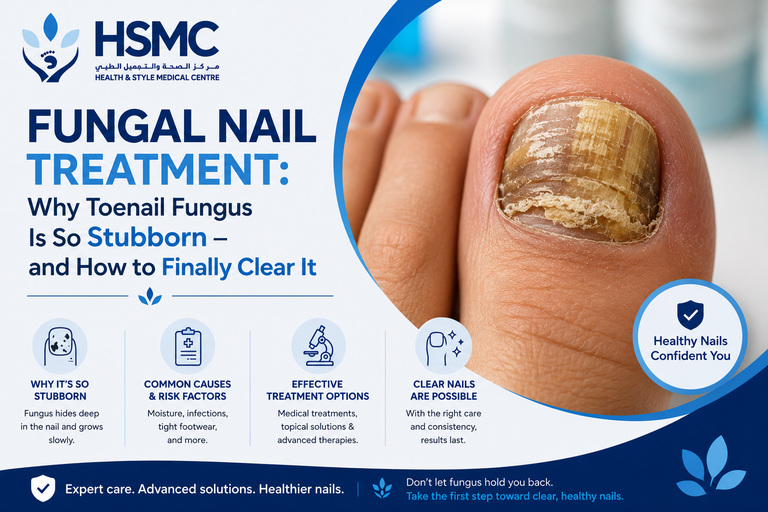
It usually starts quietly: a small white or yellow patch at the tip of a toenail. Months later, the nail is thickened, discoloured, crumbly at the edges — and you’re hiding your feet in closed shoes all year round,
even through the UAE summer.
Toenail fungus (onychomycosis) affects around one in ten adults, and it has a well-earned reputation for resisting treatment. The truth is more encouraging: fungal nail treatment works — when the right treatment is matched to the right nail. Here’s a podiatrist’s honest guide
What Does a Fungal Nail Look Like?
Discolouration — white, yellow, or brownish streaks or patches
- Thickening — the nail becomes raised and hard to trim
- Crumbling — brittle, powdery edges
- Lifting — the nail separates from the nail bed
- Odour and debris beneath the nail in advanced cases
It usually begins at the nail tip and spreads slowly toward the base —
which is exactly why early treatment is so much easier than late
treatment.
Not Every Ugly Nail Is Fungal
Studies show roughly half of suspected fungal nails are actually something else: trauma damage, psoriasis, aging changes, or bacterial issues. Months of antifungal treatment on a non-fungal nail achieves nothing — one of the biggest reasons “nothing works.” Professional diagnosis, sometimes with lab testing of nail clippings, prevents this wasted time.
How Do You Catch Toenail Fungus?
Fungi thrive in warm, dark, moist environments — which makes feet in closed shoes an ideal home, especially in the Gulf climate. Common sources and risk factors:
- Communal wet areas — pools, gyms, changing rooms, hotel bathrooms
- Sweaty feet and closed footwear for long hours
- Untreated athlete’s foot — the fungus frequently spreads from skin to nail
- Nail trauma (running, tight shoes) creating an entry point
- Salon pedicures with inadequately sterilised instruments
- Diabetes, reduced circulation, and weakened immunity
- Age — prevalence rises steadily over 50
Why Home Remedies Usually Fail
Vinegar soaks, tea tree oil, and over-the-counter paints have very low cure rates for established infections, for one simple reason: the fungus lives within and beneath the nail plate, where surface treatments barely penetrate. Meanwhile, the infection spreads — to other nails, to your skin, and potentially to family members via shared floors and bathrooms.
Fungal Nail Treatment Options That Work
Professional Nail Reduction — the Force Multiplier
A podiatrist mechanically reduces and thins the infected nail, removing fungal debris. This immediately improves comfort and appearance — and dramatically increases how well every other treatment penetrates. It’s the step home treatment can’t replicate.
Topical Antifungal Therapy
Prescription-strength lacquers and solutions applied to a professionally prepared nail work well for early, mild infections limited to part of the nail. Commitment matters: daily application for months, as the nail grows out clear.
Oral Antifungal Medication
For moderate to severe infections, oral antifungals (typically a 12-week course for toenails) offer the highest cure rates. They require a medical prescription and suitability screening — we coordinate this with your physician where appropriate.
Combined Approach — Our Standard for Stubborn Nails
The best outcomes consistently come from combining nail reduction + targeted antifungal therapy + strict reinfection control, with progress reviews as the healthy nail grows out.
A Note on Patience
Toenails grow slowly — full replacement takes 9 to 12 months. The infection can be killed early in treatment, but the nail only looks normal once it has grown out. Judge success by clear new growth at the base, not by the old damaged tip.
Stop Reinfection: The Half of Treatment Everyone Skips
Treat athlete’s foot on the skin at the same time — always
- Disinfect or replace old shoes; rotate pairs and let them dry fully
- Breathable socks changed daily; antifungal powder for sweaty feet
- Flip-flops in gyms, pools, and hotel bathrooms
- Never share nail clippers or files; ensure salons sterilise instruments — or switch to clinical podiatry nail care
- Keep nails trimmed short and straight
Frequently Asked Questions
Is toenail fungus contagious?
Can I wear nail polish during fungal nail treatment?
I have diabetes — does that change my treatment?
The fungus cleared but came back — why?
Show Your Feet Again — Book Your Fungal Nail Assessment
You don’t have to spend another year hiding your toes. At Health & Style Medical Center, our DOH-licensed podiatrists provide accurate diagnosis and complete fungal nail treatment — professional nail reduction, evidence-based antifungal therapy, and a reinfection-proof plan — with the specialist standards.
Book your nail assessment at healthstyle.ae clear, healthy nail today.

- Tags:
- diabetic foot
- foot care
- podiatrist