

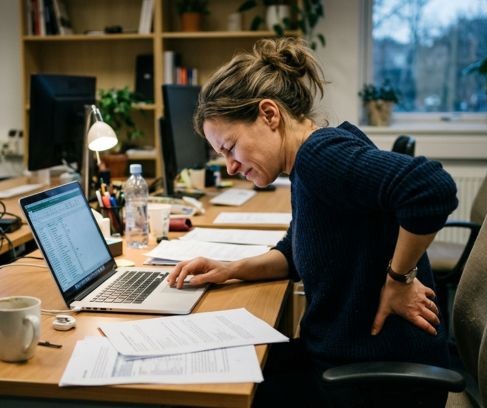
When Abu Dhabi’s working population shifted to remote work, something unexpected
happened. Within weeks, physiotherapy clinics across the city began seeing a new wave of
patients — people who had never previously experienced significant musculoskeletal pain,
now presenting with neck stiffness, lower back ache, shoulder tension, and headaches that
had appeared, seemingly from nowhere, since they started working from home.
It was not from nowhere. It was from the kitchen table. The sofa. The bedroom desk with the
screen at the wrong height. The dining chair that offers no lumbar support. The laptop that
sits too low and forces the head forward for eight hours a day.
Working from home creates a unique set of physical challenges — and in Abu Dhabi, where
many residents live in apartments not designed with home office spaces in mind, these
challenges are particularly acute. In this article, our physiotherapy team explains exactly
what working from home does to your body, how we assess postural dysfunction, and what
it takes to correct it
The WFH Posture Problem
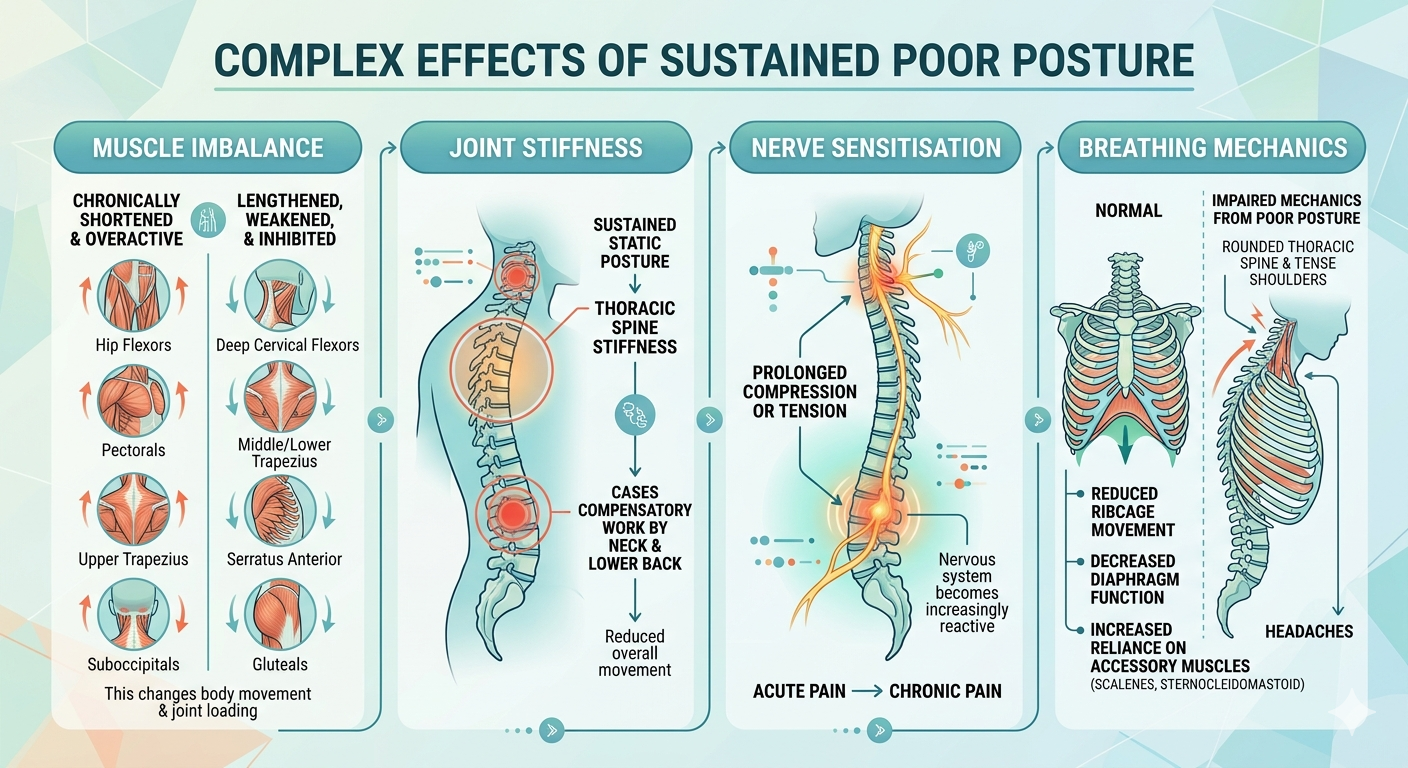
Postural problems from working at home do not simply cause aching muscles. They create a
cascade of musculoskeletal dysfunction that, if left unaddressed, becomes increasingly
difficult to reverse
Muscle imbalance: Sustained poor posture causes some muscles to become chronically
shortened and overactive — the hip flexors, pectorals, upper trapezius, and suboccipitals —
while others become lengthened, weakened, and inhibited — the deep cervical flexors,
middle and lower trapezius, serratus anterior, and gluteals. This imbalance changes the way
the body moves and loads its joints, even outside of working hours.
Joint stiffness: Sustained static postures cause the intervertebral joints to stiffen. The
thoracic spine is particularly vulnerable to this, and thoracic stiffness has a cascading effect
on the neck and lower back — both of which have to work harder to compensate for the lack
of movement above and below them
Nerve sensitisation: Prolonged compression or tension on neural structures — particularly
in the neck and lower back — can lead to peripheral nerve sensitisation, where the nervous
system becomes increasingly reactive to stimuli. This is one of the mechanisms by which
acute postural pain transitions into chronic pain.
Breathing mechanics: This is less commonly discussed but clinically important. A rounded
thoracic spine and elevated, tense shoulders impair the mechanics of breathing — reducing
the movement of the ribcage, decreasing diaphragmatic function, and increasing the
reliance on accessory breathing muscles such as the scalenes and sternocleidomastoid.
This further increases tension in the neck and can contribute to headaches
How We Assess Postural Dysfunction at Health & Style
When a patient comes to us with WFH-related postural problems, our assessment goes
considerably beyond asking them to stand up and looking at how they hold themselves.
Static postural analysis. We assess alignment from the front, side, and behind — looking
at head position, shoulder height and symmetry, thoracic kyphosis, lumbar lordosis, and
pelvic alignment. This gives us a baseline picture of the postural pattern.
Dynamic movement assessment. How the body moves tells us as much as how it stands.
We assess spinal mobility in all planes, scapular control through arm movements, hip
mobility, and the way patients transition from sitting to standing — all of which reveal the
functional consequences of their postural habits.
Muscle length and strength testing. We specifically test the key muscle groups involved
in postural dysfunction — assessing the flexibility of the hip flexors, hamstrings, and
pectorals, and the strength and activation quality of the deep cervical flexors, spinal
extensors, and scapular stabilisers.
Neurological screening. Where there is radiating pain, numbness, or tingling in the arms or
legs, we conduct a neurological screen to identify any nerve involvement.
Ergonomic history. We take a detailed history of the patient’s home working setup —
including photographs where possible — to understand the specific postural demands they
are placing on their body for eight or more hours per day.
This comprehensive picture allows us to build a treatment plan that is targeted precisely at
the individual’s specific pattern of dysfunction — not a generic posture programme, but a
plan built for their body and their working situation
The Correction Process: What Treatment Looks Like
Correcting WFH postural dysfunction requires work on several fronts simultaneously. There
is no single exercise or treatment that reverses years of poor posture — but with the right
approach, significant change is achievable within weeks.
Manual therapy. The starting point is often hands-on work to address the joint stiffness
and muscular tension that has built up. Thoracic spine mobilisation, cervical joint
mobilisation, and soft tissue work to the upper traps, levator scapulae, and pectorals create
the physical capacity for better posture that the exercises will then reinforce.
Muscle reactivation and strengthening. This is the most important phase of correction.
We systematically reactivate the inhibited muscles — starting with the deep cervical flexors
and the scapular stabilisers — and progressively strengthen them through a structured
exercise programme. This is not about doing sets at the gym. It is precise, clinically directed
activation work that builds the neuromuscular foundations of good posture.
Flexibility work. Stretching the shortened, overactive muscles — particularly the hip
flexors, pectorals, and suboccipitals — creates space for the body to adopt better
alignment. But stretching alone, without the strengthening component, rarely produces
lasting change. Both are necessary.
Movement habit retraining. We work with patients to develop new movement habits —
how to sit, how to transition between positions, how to set up their working environment,
and how to incorporate movement breaks into their day. Postural correction is not just about
exercise sessions. It is about changing the way you inhabit your body throughout every
waking hour.
Home working ergonomics. We provide detailed, practical guidance on optimising
whatever home working setup the patient has — including low-cost solutions for raising
screens, supporting the lumbar spine, and creating better working positions with whatever
furniture is available
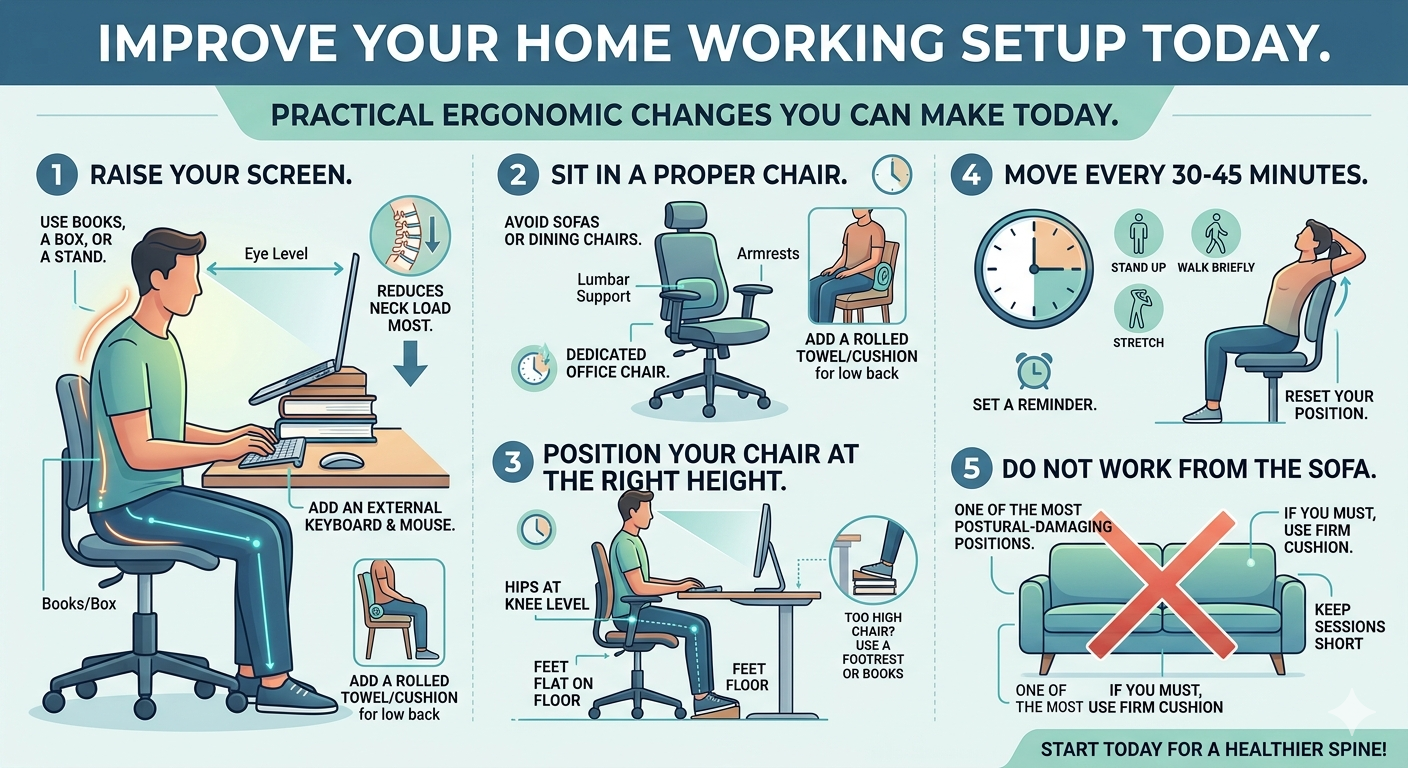
Practical Ergonomic Changes You Can Make Today
You do not need to wait for a physiotherapy appointment to begin improving your home
working setup. Here are the most impactful changes:
Raise your screen to eye level. If you use a laptop, place it on a stack of books, a box, or a
dedicated laptop stand. Buy an inexpensive external keyboard and mouse. This single
change reduces the load on the cervical spine more than any other ergonomic intervention.
Sit in a proper chair. If possible, use a chair with lumbar support and armrests rather than a
sofa or dining chair. If your chair has no lumbar support, a rolled towel or small cushion
placed in the small of the back makes a significant difference.
Position your chair at the right height. Your hips should be at approximately the same
level as your knees, with your feet flat on the floor. If your chair is too high, a footrest (or a
stack of books) under the feet resolves this.
Move every 30–45 minutes. Set a reminder. Stand up, walk briefly, stretch your thoracic
spine over the back of your chair, and reset your sitting position before returning to work.
Do not work from the sofa. We understand the appeal. But the sofa is one of the most
postural-damaging working positions possible. If you must use it occasionally, use a firm
cushion behind your lower back and keep sessions short
The Longer View: Why Early Intervention Matters
Many of the patients we see with WFH-related postural problems have been experiencing
symptoms for months before seeking help — dismissing the aching as tiredness, managing
it with painkillers, or assuming it will resolve when things get back to normal.
The longer postural dysfunction is left unaddressed, the more entrenched the muscle
imbalances become, the stiffer the joints get, and the harder the correction process. What
takes four to six sessions to address effectively at three months can take considerably
longer if left for a year or more.
If you have been working from home and have noticed new or worsening neck, back, or
shoulder pain, the time to address it is now — not when it becomes severe enough that you
cannot ignore it.
The Health & Style Approach
At Health & Style Medical Centre, we have assessed and treated hundreds of Abu Dhabi
residents with WFH-related postural dysfunction. We understand the specific challenges of
home working in this city — the apartment environments, the heat that limits outdoor
activity, the long working hours, and the cultural norms around seeking help for pain that
“isn’t that bad yet.”
Our physiotherapists provide thorough, expert assessment and a personalised treatment
programme that addresses your postural problems at their source. We also provide
practical, realistic ergonomic guidance that you can implement within the constraints of
your actual home working situation.
You do not have to accept that working from home means living in pain. With the right help,
it does not have to.
Book your postural assessment at Health & Style Medical Centre, Abu Dhabi