

Abu Dhabi has become one of the most active sporting cities in the Middle East. From the
football pitches of Zayed Sports City to the CrossFit boxes of Al Raha, the running tracks of
the Corniche, the tennis courts of Saadiyat, and the pools of Khalidiyah — this city’s
residents are training harder, competing more seriously, and pushing their bodies further
than ever before.
And with that activity comes injury.
Sports injuries are an inevitable part of an active life. But what is absolutely not inevitable is
the prolonged, incomplete, or poorly managed recovery that leaves too many Abu Dhabi
athletes — professional, amateur, and recreational alike — sidelined for longer than they
need to be, or returning to sport before they are truly ready and getting injured again.
The difference between a fast, complete recovery and a slow, frustrating one almost always
comes down to the quality and timing of the physiotherapy received.
In this article, our sports physiotherapy team explains why professional physiotherapy
produces superior outcomes in sports injury recovery, what a proper rehabilitation
programme looks like, and why starting treatment early makes such a decisive difference.
The Biology of Sports Injury Recovery
To understand why physiotherapy makes such a difference, it helps to understand what
actually happens inside the body after a sports injury.
When tissue is damaged — whether that is a muscle tear, a ligament sprain, a tendon injury,
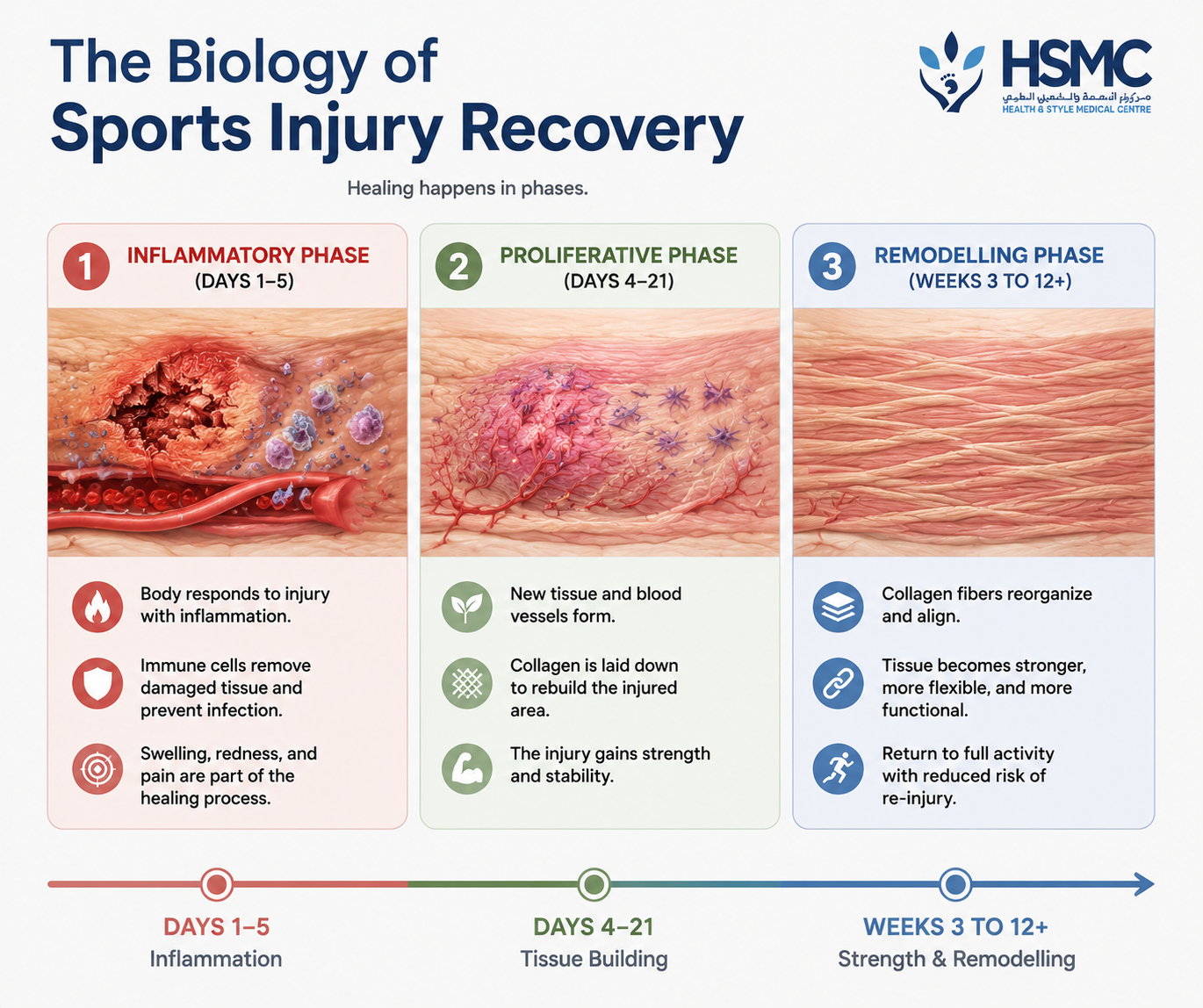
or bone stress — the body’s healing process unfolds in three overlapping phases:
The inflammatory phase (days 1–5). Immediately after injury, the body sends blood flow
and immune cells to the damaged area. Swelling, heat, redness, and pain are the visible
signs of this process. Inflammation is essential — it initiates healing. But excessive or
prolonged inflammation can delay recovery and damage surrounding tissue.
The proliferative phase (days 4–21). The body begins laying down new tissue to repair
the damage. In tendons and ligaments, this new tissue is initially composed of disorganised
collagen fibres — strong in volume but not yet strong in structure. The way this tissue
matures is heavily influenced by the mechanical loading it receives during this phase.
The remodelling phase (weeks 3 to 12+). The new tissue is progressively remodelled into
stronger, better-organised collagen in response to the specific stresses placed on it. This
phase can continue for months after the initial injury — and the quality of the final healed
tissue depends directly on how well it has been loaded and stressed during rehabilitation.
This biology explains why physiotherapy is not just a symptom management tool — it is a
direct intervention in the healing process itself. The right exercises, at the right intensity, at
the right time, produce better-quality tissue and stronger, more resilient structures than rest
alone ever can.
Why Rest Alone Is Not Recovery
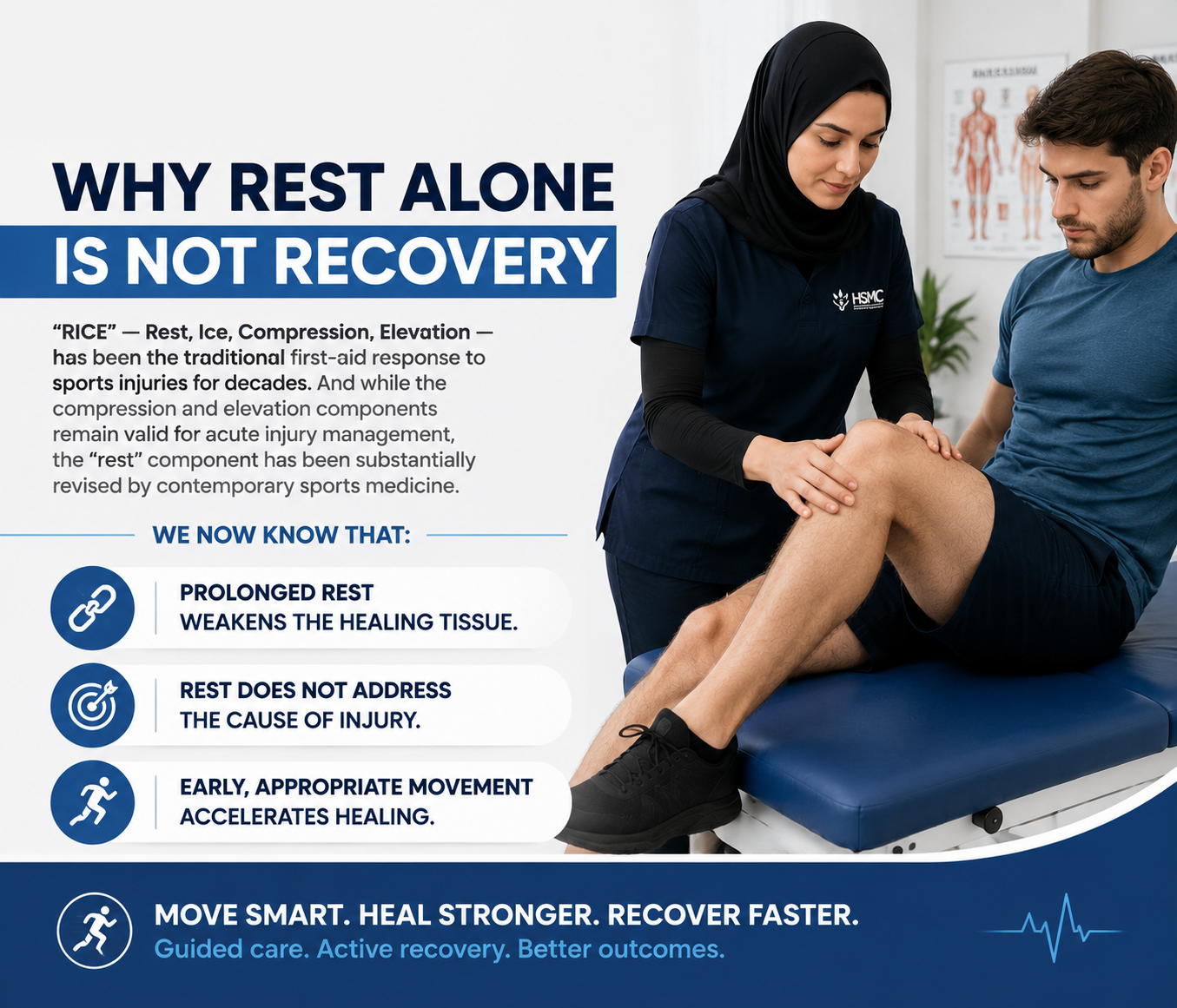
“RICE” — Rest, Ice, Compression, Elevation — has been the traditional first-aid response to
sports injuries for decades. And while the compression and elevation components remain
valid for acute injury management, the “rest” component has been substantially revised by
contemporary sports medicine.
We now know that:
Prolonged rest weakens the healing tissue. Immobilised tendons and ligaments heal with
less organised, less mechanically strong collagen. Muscles atrophy rapidly — losing up to 3
5% of their mass per day of complete rest. The longer rest continues, the greater the
deconditioning.
Rest does not address the cause of injury. Most sports injuries do not occur randomly.
They occur because of training errors, muscle imbalances, movement dysfunctions,
inadequate recovery, or biomechanical problems that place excessive load on specific
structures. Rest does nothing to identify or correct these underlying factors — meaning the
injury is likely to recur when activity resumes.
Early, appropriate movement accelerates healing. Current evidence strongly supports
early active rehabilitation — movement that is guided, progressive, and within the limits of
tissue tolerance — as the optimal approach for most sports injuries. This reduces swelling
more effectively than rest, maintains muscle strength, promotes better tissue healing, and
dramatically shortens recovery timelines.
The message is clear: rest is for the first 24–72 hours. After that, guided movement is
medicine.
The Most Common Sports Injuries We Treat in Abu Dhabi
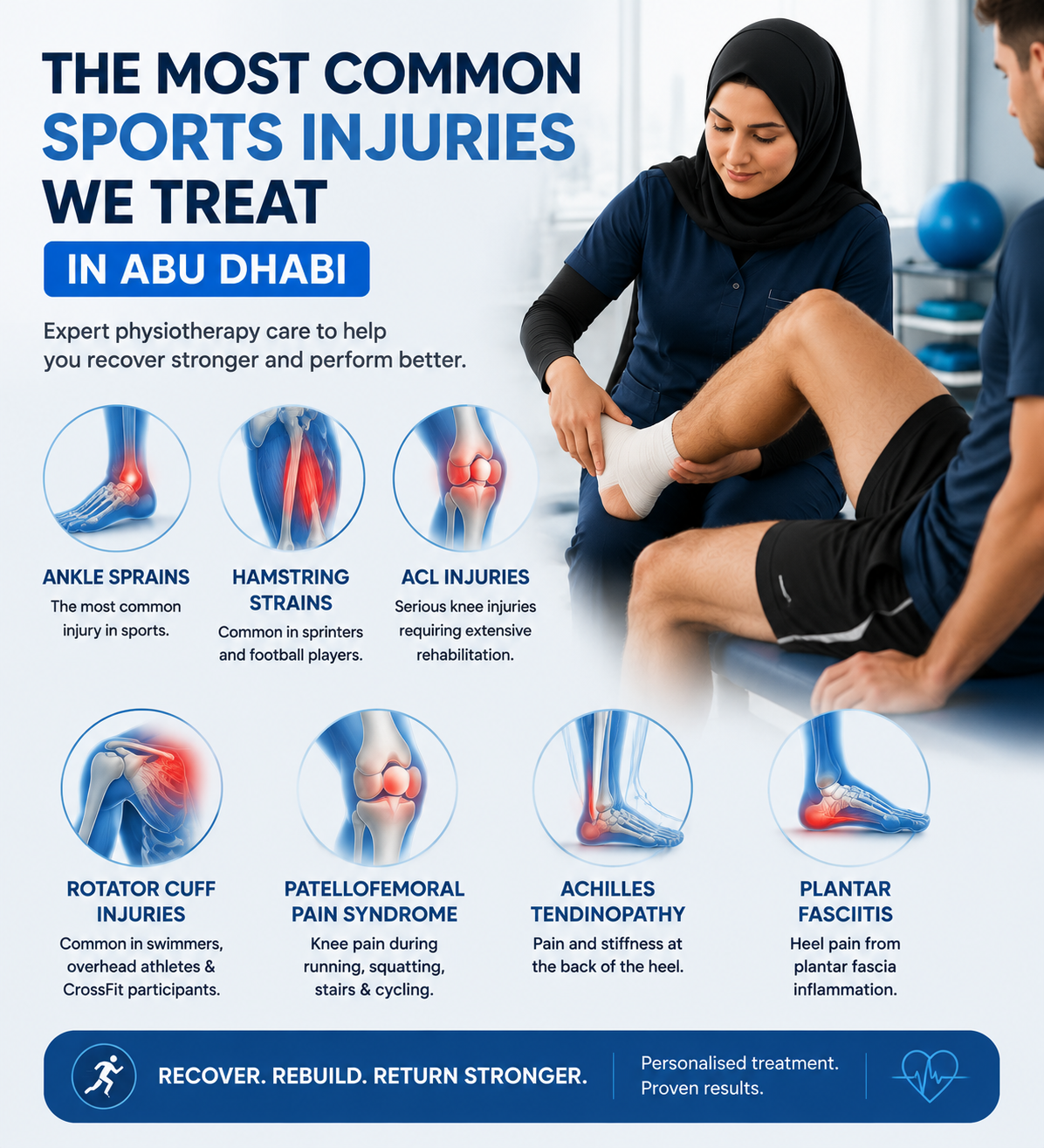
Our sports physiotherapy team treats the full spectrum of athletic injuries. The most
frequent presentations we see from Abu Dhabi’s sporting population include:
Ankle sprains. The most common sports injury across all disciplines. Lateral ankle sprains
— where the ankle rolls outward and the outer ligaments are stretched or torn — are
particularly common in football, basketball, and court sports. Despite their frequency, ankle
sprains are often undertreated, with players returning to sport too soon and developing
chronic ankle instability as a result.
Hamstring strains. A perennial problem for football players, sprinters, and any sport
requiring explosive acceleration. Hamstring injuries are notorious for their high recurrence
rate — which is almost entirely attributable to inadequate rehabilitation and premature
return to sport.
ACL injuries. The anterior cruciate ligament is one of the key stabilisers of the knee joint.
ACL tears are devastating injuries for any athlete — requiring a minimum of 9–12 months of
rehabilitation before safe return to sport. We cover ACL rehabilitation in detail in Blog #10.
Rotator cuff injuries. Common in swimmers, overhead athletes, and CrossFit participants.
The rotator cuff is a group of four muscles and tendons that stabilise the shoulder joint.
Injuries range from tendinopathy and impingement to partial and full-thickness tears.
Patellofemoral pain syndrome. A common overuse injury characterised by pain around
and behind the kneecap, particularly during activities that load the knee in flexion —
running, squatting, stairs, and cycling. Very common in runners and CrossFit athletes.
Achilles tendinopathy. Degeneration of the Achilles tendon, presenting as pain and
stiffness at the back of the heel — particularly first thing in the morning and after exercise.
Running volume, inappropriate footwear, and training load errors are the most common
contributing factors.
Plantar fasciitis. Heel pain caused by inflammation or degeneration of the plantar fascia —
the thick band of tissue on the underside of the foot. Extremely common in runners and
people who are on their feet for extended periods.
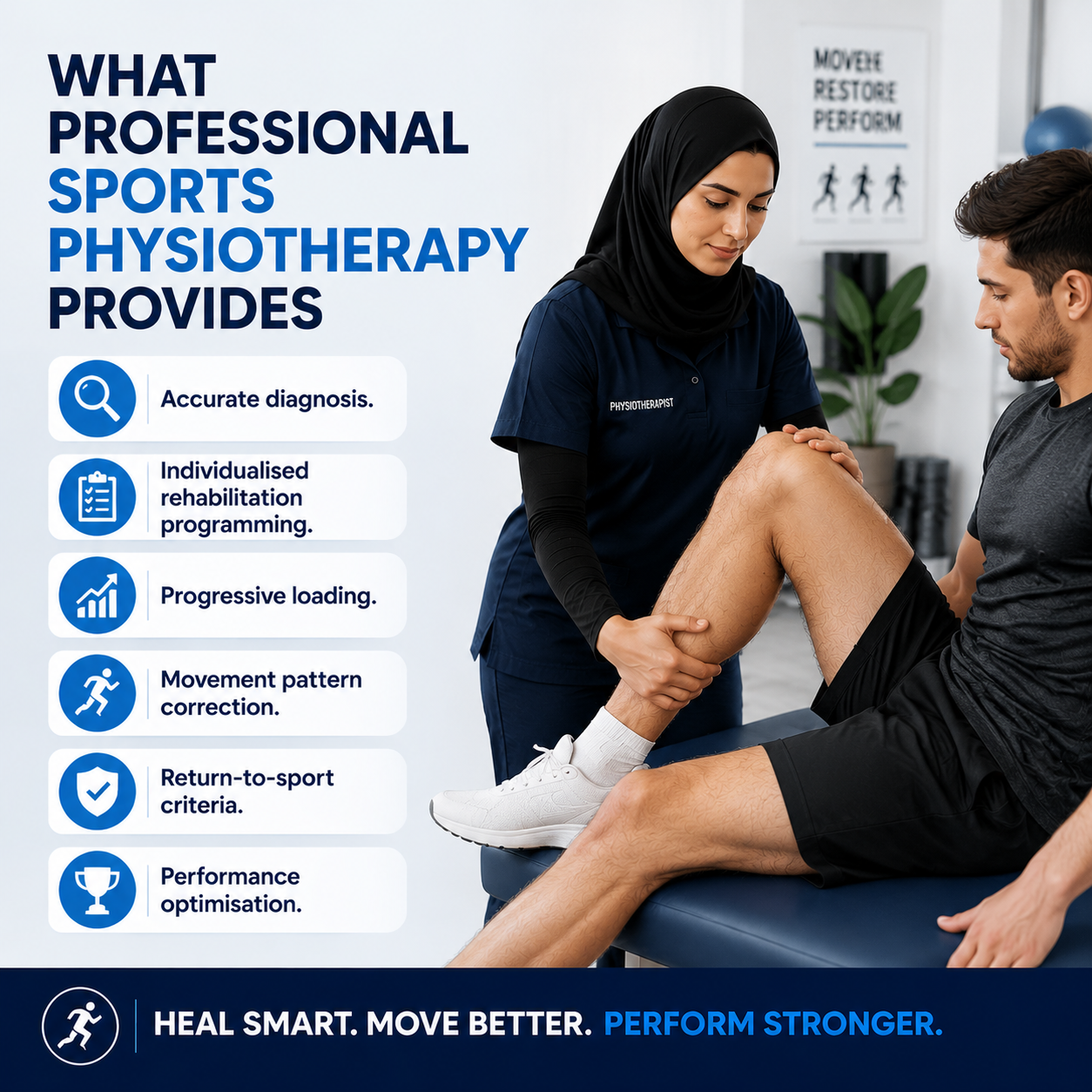
What Professional Sports Physiotherapy Provides
The difference between professional sports physiotherapy and generic injury management
is substantial. Here is what our sports physiotherapy team at Health & Style provides that
makes the difference:
Accurate diagnosis. Identifying exactly what structure is injured, the severity of the injury,
and any contributing factors requires clinical expertise. Getting this wrong leads to
inappropriate treatment and prolonged recovery.
Individualised rehabilitation programming. Cookie-cutter injury programmes produce
cookie-cutter results. Every athlete and every injury is different — and the rehabilitation
programme needs to reflect that. We design programmes specific to the injury, the sport,
the athlete’s physical condition, and their performance goals.
Progressive loading. The single most important factor in quality tissue healing is
appropriate mechanical loading — exercises that progressively stress the healing tissue at
the right level to stimulate optimal collagen remodelling. Too little load produces weak
tissue. Too much load risks re-injury. Getting this balance right requires clinical expertise
and ongoing assessment.
Movement pattern correction. Most sports injuries have a biomechanical story behind
them. Our physiotherapists identify the movement dysfunctions, muscle imbalances, and
training errors that contributed to the injury — and correct them — so that the athlete
returns to sport more resilient than they were before.
Return-to-sport criteria. One of the most important — and most often neglected —
aspects of sports injury rehabilitation is determining when an athlete is truly ready to return
to full training and competition. We use objective criteria — strength ratios, movement
quality assessments, sport-specific function tests — not just symptom resolution, to make
this determination. This is why athletes who go through proper rehabilitation have
dramatically lower re-injury rates.
Performance optimisation. For many athletes, rehabilitation is also an opportunity to
address weaknesses, imbalances, and technique issues that existed before the injury.
Athletes who embrace this perspective often return to sport physically better than they
were before they were injured.
The Cost of Inadequate Rehabilitation
The consequences of inadequate sports injury rehabilitation are well documented and
significant:
Re-injury. The single biggest predictor of future injury is a previous inadequately
rehabilitated injury. Athletes who return to sport too soon or without addressing underlying
biomechanical problems have dramatically elevated re-injury rates.
Chronic pain. Injuries that are not properly healed can develop into chronic pain conditions
that are far more difficult and time-consuming to treat than the original acute injury.
Performance decline. Sub-optimal tissue healing and persistent movement compensations
result in an athlete who is physically less capable than before the injury — even when they
feel “back to normal.”
Career limitation. In serious athletes, repeated poorly managed injuries can cumulatively
reduce an athlete’s ability to train and compete at the level they are capable of — shortening
their sporting career unnecessarily.
The investment in professional physiotherapy is an investment in avoiding all of these
outcomes.
Starting Early Makes All the Difference
One of the most consistent findings in sports injury research is that earlier initiation of
rehabilitation produces better outcomes. Patients who begin physiotherapy within the first
week of an acute sports injury consistently demonstrate faster recovery, stronger healed
tissue, and lower re-injury rates than those who delay.
This is not an argument for ignoring acute inflammation or pushing through pain. It is an
argument for seeking professional assessment as soon as possible after injury — so that
treatment can begin at the earliest appropriate stage, and so that the rehabilitation timeline
and return-to-sport plan can be established from day one.
If you have sustained a sports injury in Abu Dhabi, the best thing you can do for your
recovery is to book a physiotherapy assessment without delay.
The Health & Style Sports Physiotherapy Team
At Health & Style Medical Centre, our sports physiotherapy team has experience working
with athletes across all disciplines — from recreational weekend warriors to competitive
athletes representing their clubs, schools, and national teams. We understand the specific
demands of the sports most popular in Abu Dhabi, and we are committed to getting injured
athletes back to doing what they love — faster, stronger, and more resilient than before.
Book your sports injury assessment at Health & Style Medical Centre, Abu Dhabi.

- Tags:
- Sports Injury