

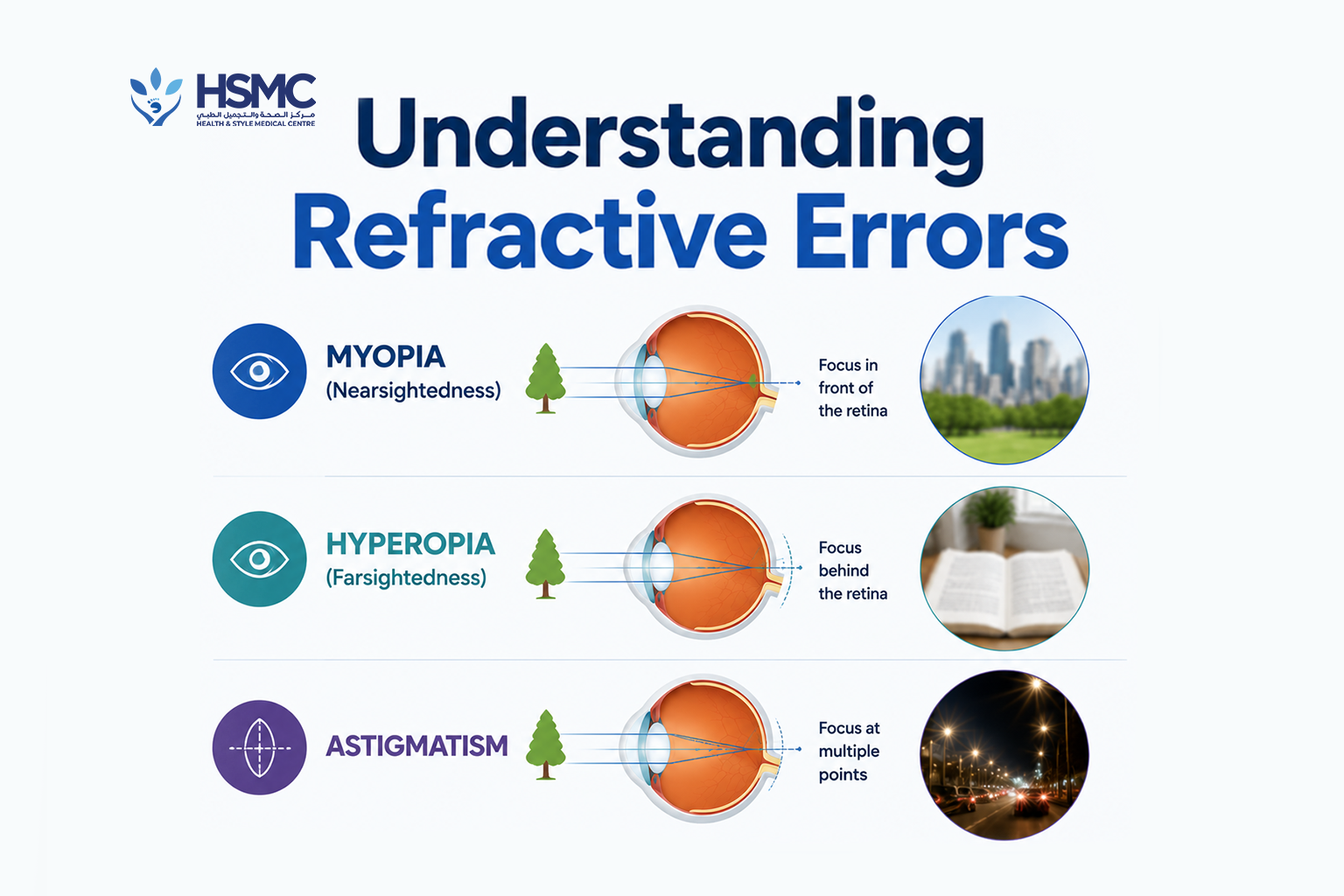
If the world looks blurry at certain distances, the most likely reason is a refractive error, simply meaning your eye does not bend light precisely onto the retina. Refractive errors are extremely common, they are not diseases, and they are easily corrected with glasses, contact lenses or surgery. Knowing which type you have helps you understand your prescription and your options.
The three main types
- Myopia (nearsightedness): close objects are clear but distant ones are blurry.
- Hyperopia (farsightedness): distant objects may be clearer than near ones, and the eyes tire with close work.
- Astigmatism: an irregularly shaped cornea blurs vision at all distances and can cause distortion.
- Presbyopia: an age-related difficulty focusing on near objects, usually after 40.
What causes them
Refractive errors are largely determined by the shape and length of your eye and the curvature of your cornea. Genetics play a strong role, and lifestyle factors such as extensive near work and limited outdoor time during childhood can influence the development of myopia in particular.
Correcting your vision
A precise refraction during an eye exam identifies your exact prescription. From there, glasses offer a simple and reliable solution, contact lenses provide freedom for sport and daily life, and laser refractive surgery can reduce or remove the need for glasses in suitable candidates. An ophthalmologist can help you choose the option that fits your eyes and lifestyle.
Get an accurate prescription and clear advice on your options at Health & Style Medical Center.