

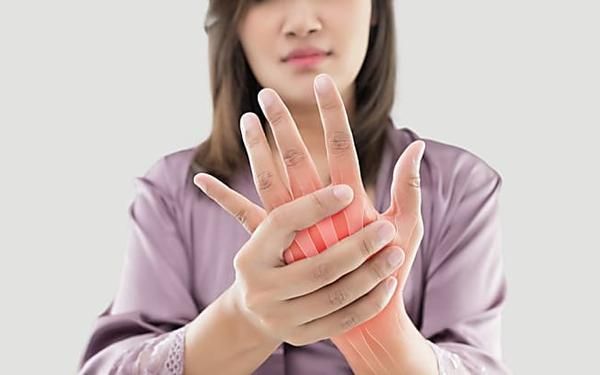
Arthritis is one of the most common chronic conditions in the world & Abu Dhabi is no
exception. This article explores arthritis, the impact of Abu Dhabi’s climate on the condition, and how physiotherapy helps individuals with arthritis stay active, maintain function, and enjoy a better quality of life.
Understanding Arthritis
Arthritis is not a single disease. It is an umbrella term for more than 100 conditions that
affect the joints — all characterized by inflammation, pain, and varying degrees of structural
joint damage. The two most common forms are:
Osteoarthritis (OA). The most prevalent form of arthritis worldwide, osteoarthritis is
characterized by the progressive breakdown of articular cartilage — the smooth, protective
tissue that covers the ends of bones within joints. As cartilage deteriorates, the joint space
narrows, bone rubs against bone, osteophytes (bone spurs) form, and the synovium
becomes inflamed. OA most commonly affects the knees, hips, lower back, neck, and
hands.
OA is strongly associated with age, obesity, previous joint injury, repetitive joint loading, and
genetic factors. In Abu Dhabi, the combination of an ageing population and high obesity
prevalence makes knee OA particularly common.
Rheumatoid arthritis (RA). An autoimmune condition in which the immune system attacks
the synovial lining of the joints, causing chronic inflammation, pain, swelling, and — if
inadequately treated — progressive joint destruction. RA typically affects the small joints of
the hands and feet symmetrically and is associated with systemic symptoms including
fatigue, morning stiffness, and general malaise.
Other forms of inflammatory arthritis — including psoriatic arthritis, ankylosing spondylitis,
and gout — are also treated by our physiotherapy team.
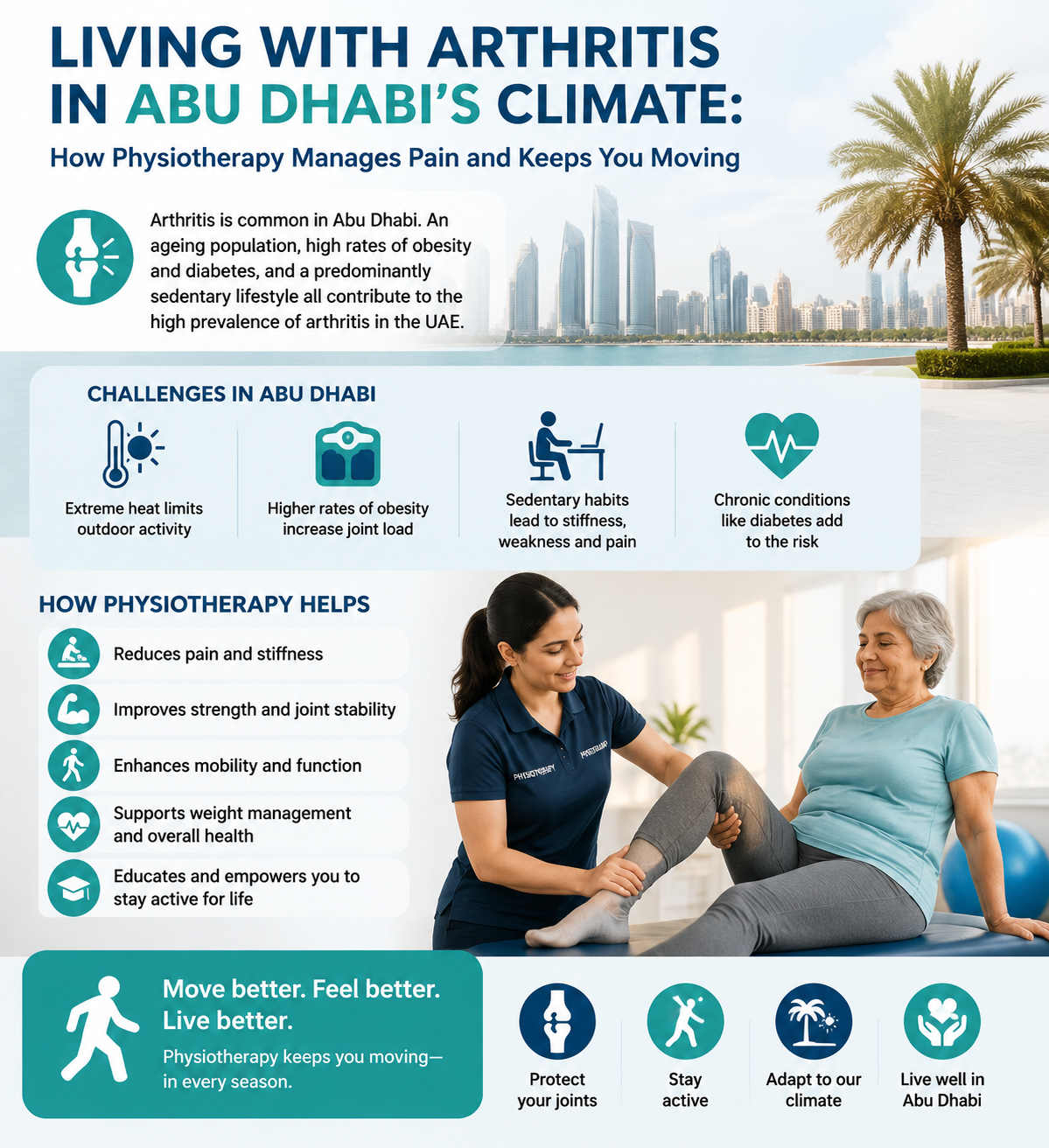
How Abu Dhabi’s Climate Affects Arthritis
The relationship between climate and arthritis symptoms is a genuine and well-recognised
phenomenon, though the mechanisms are not fully understood. In Abu Dhabi, several
climate-specific factors are clinically relevant.
Temperature extremes and air conditioning. The dramatic temperature differential
between Abu Dhabi’s outdoor heat (often above 40°C in summer) and the heavily air
conditioned indoor environments that residents spend most of their time in creates a
constant thermal challenge for arthritic joints. Many patients report increased joint stiffness
and pain in highly air-conditioned environments — particularly if cold air is directed at
affected joints. The muscle tension response to cold further reduces joint mobility and
amplifies pain.
Humidity. Research on the relationship between humidity and arthritis symptoms is mixed,
but many patients report worsening symptoms during periods of high humidity — which in
Abu Dhabi occurs particularly in the late summer months. Barometric pressure changes
associated with weather fluctuations may affect the pressure within joint capsules,
influencing pain perception.
Limited outdoor activity. The heat that dominates Abu Dhabi for six to eight months of the
year dramatically reduces the opportunity for outdoor walking, exercise, and movement —
all of which are essential for joint health. Sedentary behaviour, which worsens both OA and
RA, is a natural consequence of a climate that makes outdoor activity genuinely
uncomfortable or dangerous for much of the year.
Vitamin D deficiency. As discussed in the context of osteoporosis, vitamin D deficiency is
endemic in the UAE. Vitamin D plays a role in musculoskeletal health and immune regulation
— and its deficiency has been associated with increased pain sensitivity and poorer
outcomes in both OA and RA.
The Exercise Paradox in Arthritis
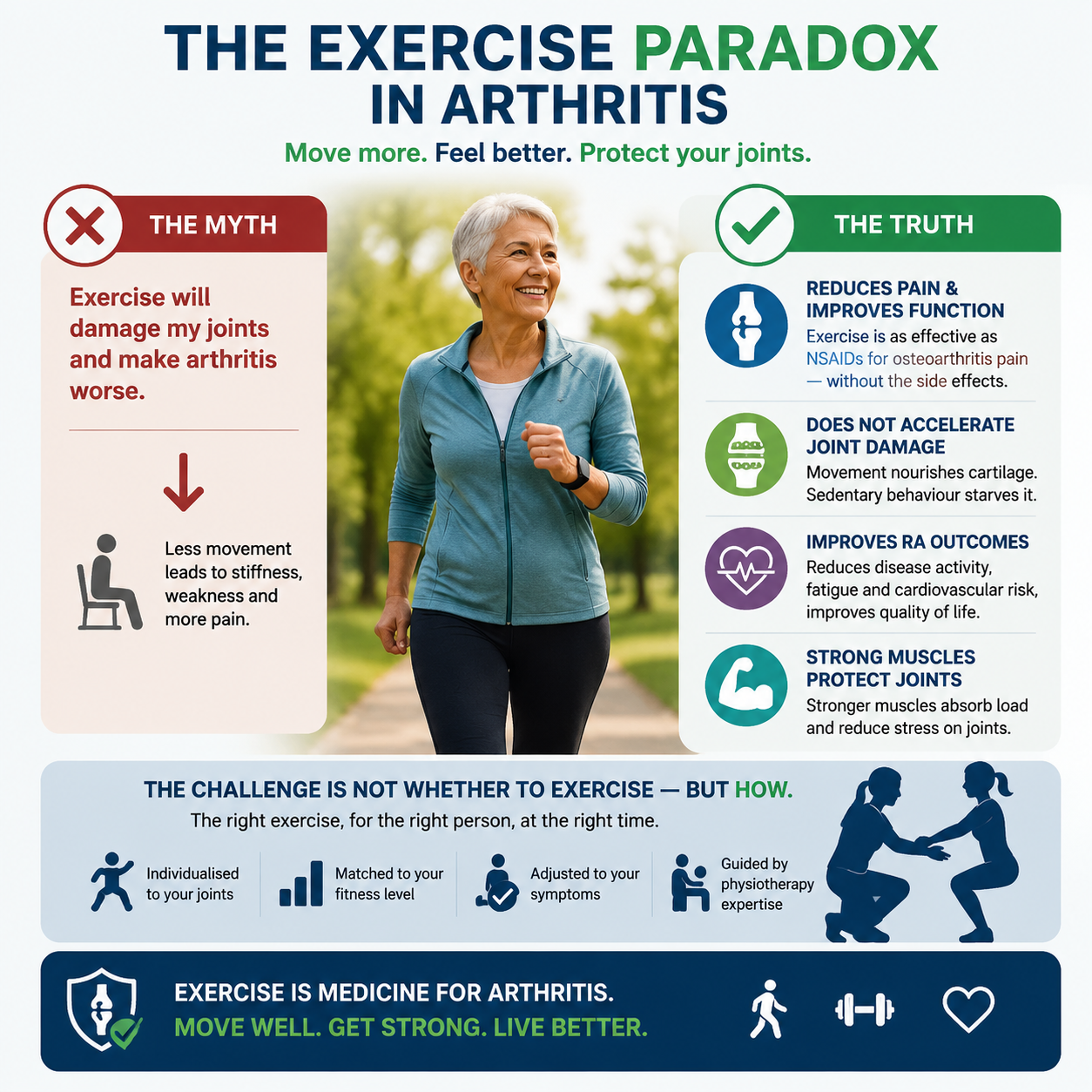
One of the most persistent and damaging misconceptions about arthritis is that exercise is
harmful — that moving an arthritic joint will accelerate its damage and worsen the condition.
This belief leads many people with arthritis to reduce their activity significantly, becoming
increasingly sedentary — which, in reality, makes arthritis considerably worse.
The evidence on exercise and arthritis is unambiguous:
Exercise reduces pain in osteoarthritis. Multiple systematic reviews and meta-analyses
have demonstrated that regular, appropriate exercise produces clinically meaningful
reductions in pain and improvements in function in patients with knee, hip, and hand OA.
The effect size is comparable to that of non-steroidal anti-inflammatory drugs (NSAIDs) —
and without the side effects.
Exercise does not accelerate joint damage. In patients without acute joint inflammation,
appropriate exercise does not worsen the structural changes of OA. Cartilage is relatively
avascular — it receives its nutrition from synovial fluid, which is circulated by joint
movement. Regular movement nourishes cartilage; sedentary behaviour starves it.
Exercise improves RA outcomes. Regular physical activity reduces disease activity,
improves cardiovascular health (a major concern in RA due to elevated cardiovascular risk),
reduces fatigue, and improves quality of life in rheumatoid arthritis patients.
Muscle strength protects joints. Strong muscles around an arthritic joint absorb load that
would otherwise pass through the joint surfaces. Quadriceps weakness, for example, is one
of the strongest predictors of symptom progression in knee OA. Strengthening the muscles
around arthritic joints is one of the most effective treatments available.
The challenge is not whether to exercise — it is how to exercise appropriately for each
patient’s specific joint involvement, fitness level, and symptom status. This is precisely
where physiotherapy expertise is essential.
What Physiotherapy Provides for Arthritis Patients
Comprehensive assessment. Our physiotherapists assess joint range of motion, muscle
strength, movement patterns, balance, and functional capacity — identifying the specific
impairments driving each patient’s pain and disability. We also assess cardiovascular
fitness, weight, and lifestyle factors that influence arthritis management.
Exercise prescription. We design and supervise an individualized exercise programme that
progressively builds the strength, flexibility, and cardiovascular fitness that arthritis
management requires — adapted to each patient’s joint involvement, fitness level, and pain
status. For knee OA, this typically includes quadriceps and hip strengthening, balance
training, and graduated aerobic exercise. For RA, we adapt exercise to the patient’s disease
activity and ensure that exercise during flares is appropriately modified.
Manual therapy. Joint mobilization can relieve pain and improve range of motion in early arthritis, while soft tissue therapy eases muscle tension and secondary pain from altered movement.
Hydrotherapy guidance. Exercise in water is particularly valuable for arthritis patients, as
the buoyancy of water significantly reduces joint loading.
Taping and bracing. Specific taping techniques — particularly patellar taping for knee OA —
have strong evidence for reducing pain and improving function. Knee bracing, foot orthoses,
and wrist splints may also be appropriate in specific presentations.
Pain education. Understanding the nature of arthritic pain is one of the most powerful tools for improving outcomes in chronic arthritis. Patients who understand their pain are less likely to develop the fear-avoidance behaviours that accelerate disability.
Lifestyle advice. We provide practical guidance on weight management, sleep, pacing strategies, and activity modification that allows patients to manage their symptoms.
Managing Flares
Both OA and inflammatory arthritis can produce flares and pain that temporarily worsen symptoms and require management adjustment.
During a flare, physiotherapy goals shift from progression to maintenance and symptom
management:
1. Gentle range of motion exercises to prevent stiffness without aggravating inflammation
2. Activity modification to reduce load on acutely inflamed joints
3. Ice or heat application as appropriate to the patient’s preference and clinical situation
3. Close liaison with the rheumatologist or physician managing the patient’s medication.
Understanding how to manage flares effectively is a key component of physiotherapy education for arthritis patients.
You Can Live Well with Arthritis
Arthritis does not have to mean progressive disability, growing restriction, and
increasing dependence on pain medication. With the right physiotherapy, majority of
people with arthritis can manage their pain effectively, and continue living active, fulfilling lives.
The approach that works is active, not passive. It requires engagement and effort. But the
outcomes it produces are real, meaningful, and lasting
Book your arthritis physiotherapy assessment at Health & Style Medical Centre, Abu
Dhabi.

- Tags:
- arthritis
- joint pain
- physiotherapy