


There is a particular kind of pain that sciatica sufferers describe in a way that is instantly
recognizable to any physiotherapist. It is not just pain. It is a burning, shooting, electric
sensation that starts somewhere in the lower back or buttock and travels — sometimes all
the way to the foot. It can arrive without warning, stop you mid-stride, and make sitting in a
car or at a desk feel close to unbearable.
Sciatica is one of the most common and most debilitating pain conditions we treat at Health
& Style Medical Centre. It affects people across Abu Dhabi from all walks of life — desk
workers, construction workers, athletes, new mothers, and retirees alike. And in our clinical
experience, the majority of people who have it wait far too long before seeking help.
This article will explain exactly what sciatica is, what causes it, and — most importantly —
give you seven clear signs that it is time to stop managing your symptoms alone and see a
physiotherapist without further delay
What Is Sciatica?
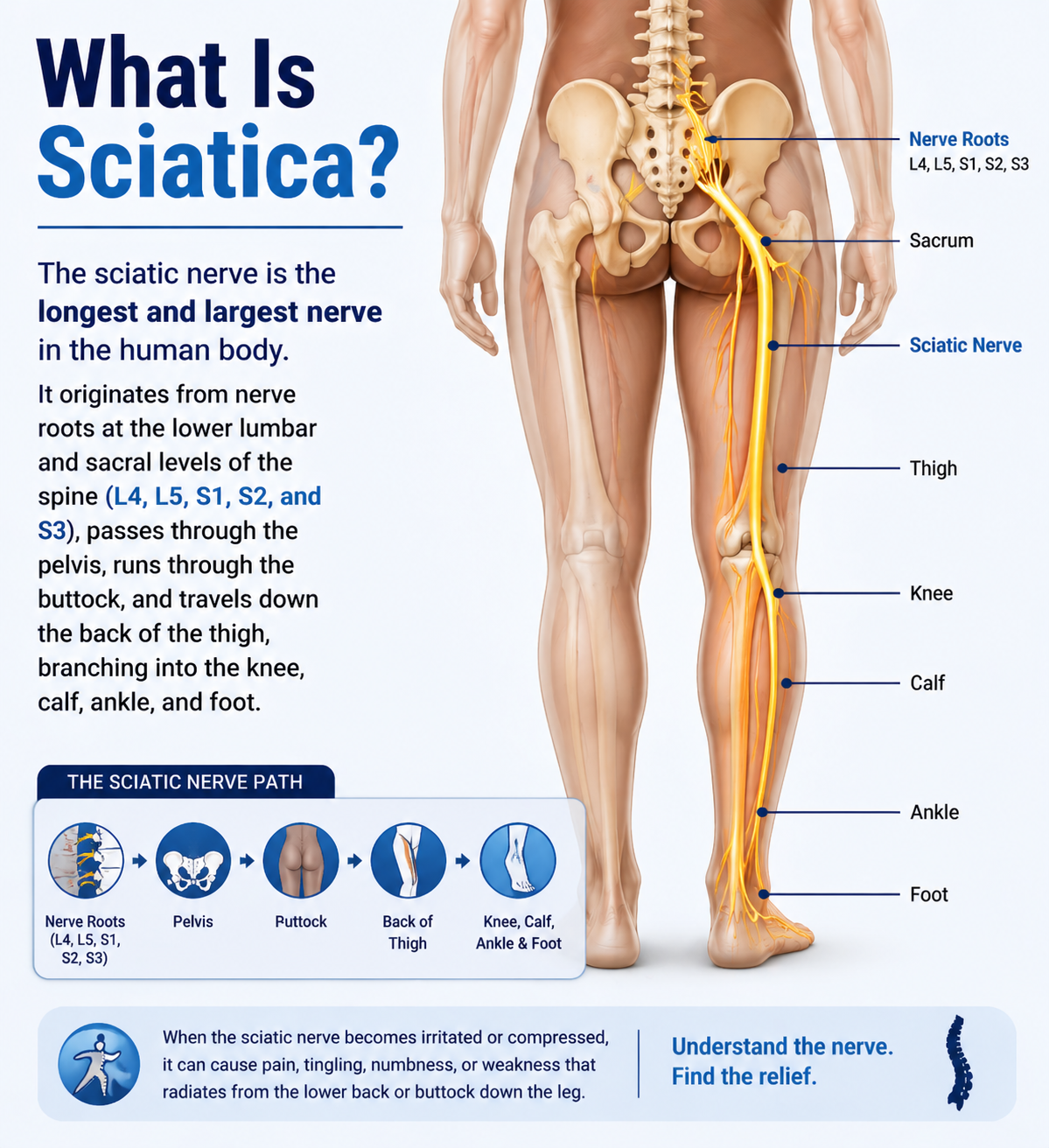
The sciatic nerve is the longest and largest nerve in the human body. It originates from
nerve roots at the lower lumbar and sacral levels of the spine (L4, L5, S1, S2, and S3),
passes through the pelvis, runs through the buttock, and travels down the back of the thigh,
branching into the knee, calf, ankle, and foot.
Sciatica refers to pain — and often other neurological symptoms — that occurs along the
path of this nerve as a result of compression or irritation at its origin.
The most common cause is a disc herniation at the L4/L5 or L5/S1 level, where bulging disc
material presses directly on one of the nerve roots that forms the sciatic nerve. Other
causes include spinal stenosis (narrowing of the spinal canal), piriformis syndrome (where
the sciatic nerve is compressed by the piriformis muscle in the buttock), spondylolisthesis
(a slippage of one vertebra over another), and in some cases, pregnancy
Why Sciatica Demands Attention
Sciatica is not back pain with a bit of leg discomfort thrown in. It is a neurological condition
as much as a musculoskeletal one — meaning that the nerve itself is under threat, not just
the surrounding muscles and joints.
When a nerve is compressed, it initially responds with pain and altered sensation. But
sustained or severe compression can lead to neurological deficit — measurable weakness in
the muscles supplied by that nerve, or areas of numbness that do not resolve. These
deficits can, in some cases, become permanent if the nerve compression is not relieved in
time.
This is why sciatica demands timely, appropriate treatment. Not because it cannot be
resolved — the vast majority of cases respond very well to physiotherapy — but because
delay can allow a manageable problem to become a more complex one.
7 Signs You Need Physiotherapy Right Now

1: The Pain Has Been Present for More Than Two Weeks
Occasional, mild sciatic pain that resolves within a few days may simply reflect a transient
irritation of the nerve — perhaps from a period of unusual activity, prolonged sitting, or a
minor postural strain. This kind of brief episode often settles on its own.
But if your sciatic symptoms have been present consistently for more than two weeks, this
is a clear indicator that the underlying cause is not resolving spontaneously and requires
professional assessment and treatment. The longer nerve compression persists without
intervention, the more entrenched the inflammatory process becomes and the more
complex the recovery.
Do not wait for it to go away on its own. If it has not gone in two weeks, it needs help to go
2: The Pain Is Travelling Below the Knee
Sciatic pain that remains in the lower back and buttock area represents nerve irritation in its
earlier stages. When the pain begins to travel below the knee — into the calf, shin, ankle, or
foot — this indicates a higher level of nerve involvement and a greater degree of
compression or irritation.
Pain below the knee, particularly pain that reaches the foot or toes, should always prompt a
physiotherapy assessment. It tells us that the nerve is under significant stress, and that
without targeted treatment to relieve that stress, the condition is unlikely to improve.
3: You Are Experiencing Numbness or Tingling
Numbness, tingling, or a pins-and-needles sensation in the leg, foot, or toes is a sign that
the nerve is not only being compressed but that this compression is beginning to affect its
ability to transmit signals normally.
These sensory changes are important clinical signs that a physiotherapist will use to identify
exactly which nerve root is affected and how severely. They also indicate that the situation
has moved beyond simple muscular pain into genuine neurological involvement — which
makes prompt, expert assessment all the more important.
4: Your Symptoms Are Worse When Sitting
One of the hallmarks of disc-related sciatica is the significant worsening of symptoms when
sitting, particularly for prolonged periods. This is because sitting increases the pressure on
the intervertebral discs and can further compress the already irritated nerve root.
If you find that sitting at your desk, in your car, or on a chair for more than twenty to thirty
minutes significantly worsens your leg pain or neurological symptoms — and that you need
to stand or lie down to get relief — this is a classic pattern of lumbar disc herniation with
nerve root compression.
This pattern responds very well to physiotherapy, but it also indicates that the disc problem
is significant enough to be meaningfully affecting your daily function. It warrants
professional assessment and treatment.
5: You Are Starting to Notice Weakness in Your Leg or Foot
This is one of the most important warning signs on this list. Pain and altered sensation are
distressing, but weakness is a sign of more advanced neurological compromise.
Weakness may present as difficulty lifting the foot when walking (foot drop), difficulty rising
onto the toes, a sense that the leg feels unreliable or gives way unexpectedly, or weakness
when climbing stairs.
If you notice any of these features, you should seek physiotherapy assessment urgently —
within days, not weeks. Measurable muscle weakness indicates that the nerve is being
significantly compressed and that its function is being impaired. While physiotherapy can
often resolve this effectively, the window for optimal recovery narrows the longer the deficit
persists.
6: Your Sleep Is Being Disrupted
Sciatica that is bad enough to wake you from sleep, prevent you from finding a comfortable
sleeping position, or leave you exhausted from a night of pain is not sciatica you should be
managing with over-the-counter painkillers and a hot water bottle.
Sleep is when the body repairs itself. When pain disrupts sleep consistently, it impairs
recovery, increases pain sensitivity, and contributes to the development of central
sensitisation — a process by which the nervous system becomes progressively more
reactive to pain signals, making the condition harder to treat over time.
Sleep-disrupting sciatica needs professional treatment. A physiotherapist can not only
address the source of the nerve compression but also advise on sleeping positions and
supports that can reduce nocturnal symptoms while treatment takes effect.
7: You Have Tried to Manage It Yourself Without Success
You have rested. You have stretched. You have watched videos online and followed the
exercises. You have taken ibuprofen and applied heat and ice. And the pain is still there —
perhaps a little better, perhaps no different, perhaps gradually worse.
Self-management has its place in mild, acute sciatic episodes. But if you have been trying to
manage your symptoms independently for more than two to three weeks without meaningful
improvement, continuing the same approach will not produce a different result.
Sciatica has a specific cause — a specific nerve, at a specific level, compressed by a
specific structure. Identifying that cause requires clinical assessment. Treating it effectively
requires targeted, professional intervention. There is no generic stretch or exercise
programme that works for every presentation of sciatica, because sciatica is not one single
condition — it is a symptom that can arise from several different causes, each of which
requires a different treatment approach.
A physiotherapist will assess your individual presentation, identify the cause, and design a
treatment programme built specifically for your situation.
What Physiotherapy for Sciatica Actually Involves
At Health & Style Medical Centre, our assessment of sciatica begins with a thorough
neurological examination — testing reflexes, sensation, and muscle strength in the affected
leg — combined with a detailed assessment of the lumbar spine and pelvis.
This allows us to identify not only which nerve root is affected and the likely cause of
compression, but also the severity of the neurological involvement and the most appropriate
treatment direction.
Treatment typically involves a combination of:
Directional exercise therapy. Based on the McKenzie assessment approach, we identify
the specific movements and positions that reduce your nerve symptoms — often extension
based exercises for disc-related sciatica — and use these as the foundation of your home
exercise programme.
Neural mobilisation. Specific techniques that gently mobilise the sciatic nerve along its
entire length, reducing neural tension and improving the nerve’s ability to slide and glide
through surrounding tissues. These are significantly more effective — and safer — than the
generic “piriformis stretches” that circulate on social media.
Lumbar joint mobilisation and manipulation. Hands-on therapy to reduce pain, restore
movement, and address the joint dysfunction that is often part of the overall clinical picture.
Core stabilisation. Progressive rehabilitation of the deep spinal stabilisers to reduce the
load on the affected disc or joint and support long-term recovery.
Education and activity modification. Understanding which positions and movements to
temporarily avoid — and which to actively pursue — is a critical part of managing sciatica
effectively in daily life
When Sciatica Requires Urgent Medical Attention
Before concluding, it is essential to reiterate the symptoms that constitute a medical
emergency rather than a physiotherapy referral:
Sudden loss of bladder or bowel control
Numbness in the saddle area (inner thighs, perineum, genitals)
Rapidly progressive weakness affecting both legs
These symptoms may indicate cauda equina syndrome — a rare but serious spinal
emergency. If you experience any of these, go immediately to the emergency department.
Do not wait for a physiotherapy appointment.
The Health & Style Approach
Sciatica is one of the conditions we treat most frequently and most successfully at Health &
Style Medical Centre. The key is accurate assessment, targeted treatment, and a patient
who understands what is happening and why.
If you recognise yourself in any of the seven signs described in this article, we would
strongly encourage you to book an assessment with our team. The sooner we can identify
what is causing your sciatic symptoms and begin addressing it, the faster and more
completely you will recover.
Book your physiotherapy assessment at Health & Style Medical Centre, Abu Dhabi.